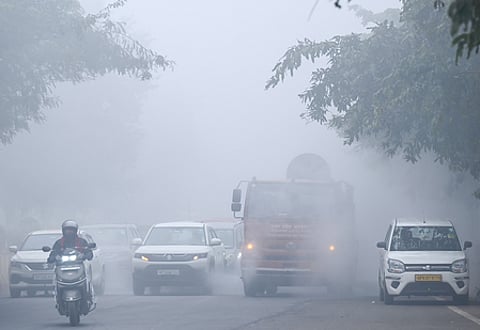

The government has proposed to roll out stricter Bharat Stage-VII (BS-VII) emission standards in a phased manner for new cars and SUVs from April 1, 2029, followed by small goods delivery and pick-up vans from 2030. The new standards for buses and heavy-duty vehicles are proposed from April 2031.
Under the proposed norms, additional requirements to control brake-particle emissions, tyre abrasion and particulate emissions are proposed, along with stricter limits on harmful pollutants, including nitrogen oxides (NOx), hydrocarbons and particulate matter (PM). The proposed standards will, however, not affect existing vehicles or their life, including those compliant with existing BS-VI specifications.
The ministry of road transport and highways recently issued draft notifications to amend the Central Motor Vehicles Rules, 1989, inviting comments from the public on the proposed exhaust norms. The objections or suggestions received will be considered by the Central government before BS-VII standards are finalised.
As per the draft, vehicles have to be equipped with an On-Board Monitoring system (OBM), capable of monitoring and registering all exhaust emissions of NOx and PM and detecting exceedances of at least 2.5 times the relevant exhaust emission limit.
The vehicles will also be equipped with an On-Board Fuel and electric energy Consumption Monitoring (OBFCM) system, capable of monitoring their real-world fuel and electric energy consumption and other relevant parameters, which are needed to determine their real-world fuel and energy efficiency.
The proposed norms also mandate that an Environmental Vehicle Passport (EVP) will be made available to users along with certificate of conformity and the type-approval documentation. Vehicle users will also have access to up-to-date information about fuel consumption, the state of health of traction batteries, pollutant emissions and other relevant information generated by on-board systems and monitors. Provisions for in-vehicle display of EVP has also been made in the draft notification.
New emission standards for two-wheelers are expected to be notified later. BS, or Bharat Stage, refers to India’s vehicle emission standards that set limits on pollutants such as carbon monoxide (CO), NOx, hydrocarbons (HC) and PM. These standards are aligned with European emission norms and are enforced to gradually phase out vehicles that emit higher levels of pollutants.
BS-VI came into force in April 2020. India skipped BS-V and moved directly to BS-VI to accelerate pollution control. These vehicles emit far lower pollutants and require low-sulphur BS-VI fuel.
Why are BS-VII emission standards significant?
While BS-VI mandated stringent limits on pollutants released by petrol and diesel vehicles, the proposed BS-VII is to strengthen the mechanism for measuring and monitoring emissions. It also addresses pollution from sources beyond the exhaust pipe including electric vehicles (EVs).
The proposal is modelled broadly on Europe’s Euro 7 regulatory framework, which also covers brake emissions, tyre abrasion and the durability of electric vehicle batteries.
Under the BS-VII framework, the government introduces a broader approach to vehicle pollution control; combines laboratory and real-world testing with greater on-board monitoring, controls on brake and tyre particles and battery durability requirements instead of trusting principally on specified exhaust limits and laboratory certification.
How does BS-VII strengthen vehicle emission controls?
Major pollutants, including nitrogen oxides (NOx), carbon monoxide (CO), hydrocarbons and particulate matter (PM) are covered under the proposed standards. These pollutants contribute to harmful air pollution, respiratory health risks and the formation of ground-level ozone and other secondary pollutants.
Importantly, the draft does not simply lower every existing tailpipe emission limit for passenger cars. For example, the proposed principal limits for NOx remain at 60 milligrams (mg) per kilometre (km) for petrol vehicles and 80 mg/km for diesel vehicles. The PM limit remains at 4.5 mg/km. However, the particulate number threshold has been cut down from 23 nanometres (nm) to 10 nm to arrest smaller ultrafine particles.
A key change is how compliance is assessed and emissions monitored. Vehicles must control pollution under actual operating conditions.
How will real-world driving tests make a difference?
Laboratory tests offer a controlled way to measure vehicle emissions but actual driving involves changing speeds, acceleration, traffic congestion, road gradients, temperatures and other conditions that can severely affect pollution levels. The draft proposes real-driving emissions (RDE) testing alongside laboratory testing. From April 1, 2030, passenger vehicles would undergo RDE testing during type approval, using portable emissions measurement systems to assess pollution while the vehicle is driven under prescribed real-world conditions.
A proposed conformity factor of 1.0 for NOx and particle numbers will apply to relevant RDE tests. This conformity factor means that vehicles will be required to emit no more than the legal laboratory emission limits during the test.
What role will on-board monitoring play?
The rules proposed would expand the use of on-board systems to detect, report emissions and monitor vehicle performance. On-board diagnostics (OBD) help identify faults in vehicle systems, including components involved in pollution control. The proposed on-board monitoring framework will add further oversight of emissions, while on-board fuel consumption monitoring will track fuel or energy use.
Why does BS-VII cover brake dust and tyre wear?
Vehicle pollution is not exclusively from engines. Braking generates particles as brake components wear down while tyres release particles through abrasion against the road. These sources are particularly important because they can continue to generate particulate pollution even when a vehicle has zero tailpipe emissions.
Therefore, for passenger vehicles, the draft proposes brake-particle limits from April 1, 2031. The proposed PM10 limit is three mg/km for battery-electric vehicles and seven mg/km for specified other powertrains, including conventional engine vehicles and hybrids. A uniform limit of three mg/km is proposed from April 1, 2035.
What are the proposed requirements for EVs?
The proposed framework recognises that EVs do not produce tailpipe emissions during normal electric driving but they still have an impact on the environment. Therefore, brake and tyre particles, battery durability and energy-consumption monitoring are relevant although specific requirements vary by powertrain and minimum battery durability requirements for electric passenger cars and plug-in hybrids.
Under the proposed energy-retention thresholds, the vehicles will have to retain at least 75% of the battery’s initial energy capacity after five years or one lakh km, whichever comes first. And it is at least 67% after eight years or 1.60 lakh km, whichever comes first.
Simply, a battery will require keeping a minimum share of its original energy capacity over time and use. This is to ensure that battery performance is assessed over the vehicle’s life rather than only when it leaves the factory. Battery durability will measure how well it retains its usable energy capacity as it ages. The norm could also make battery-health information more relevant to owners assessing a used electric vehicle.
Impact of BS-VII on the automobile industry and car buyers?
Manufacturers could require additional investment in emissions-control technology, testing equipment, monitoring systems and battery-management capabilities. Redesigning of components or changing vehicle-development schedules may further be needed to meet the applicable requirements.
The prices of new vehicles are likely to go up as research, engine-upgrading, and compliance will require investment. The additional cost will ultimately pass on to consumers. The real impact, however, on vehicle prices and maintenance cost cannot be determined as of now as it will depend on the final requirements, the technology adopted by the manufacturers and the costs of compliance.
