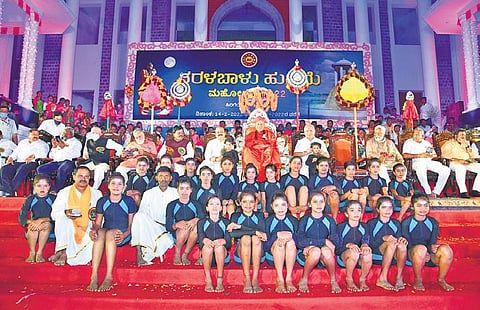

CHITRADURGA: This is another version of the great Indian rope trick: asanas and acrobatics mid-air, entwined in a hagga (rope). Malli Hagga, which literally means ‘woman performing on a rope’, is an aerial sport in which gymnasts perform various exercises and yoga, swinging flawlessly and walking nimbly in air.
While rope gymnastics and rope ballet are popular internationally, the sport is relatively new at the Taralabalu School in Sirigere, Chitradurga district. Students who have been learning this sport for the past five years, have already displayed their skill on various national platforms.
Malli Hagga is an offshoot of the Mallakhamb, a sport performed on a pole. It involves the performance of acrobatics and yogasanas on a crossbar, fixed at a height of more than 10 feet, using a rope. As the girls climb swiftly on to the crossbar and display their expertise in padmasana, parvatasana, shavasana, Bajarangi pakad and Nataraja asana, the audience is left stunned. Such tricks require skill, balance, dedication, confidence, a fit body and an alert mind.
During a competition, a Malli Hagga exponent has to perform 10 various acts, exercises or asanas in 90 seconds, in the first round or compulsory set. In the second round or optional set, they can select exercises of their choice. Their performance is assessed by a panel of three to five judges, on parameters like the degree of difficulty of the exercise, execution, grace and coordination.
Manjunath B Kolachi, who has been training girls from the age of 3 to 21 years since 2017, says, “This sport has all the qualities of modern-day gymnastics. If the girls who are trained continue with gymnastics, they have huge potential to win medals for the country on an international platform.” Until now, more than 500 girls have learnt the sport.
Earlier known as the rope trick of Mallakhamb, it was named ‘Malli Hagga’ by the seer of Taralabalu mutt Dr Shivamurthy Shivacharya Swamiji, after watching the girls perform acrobatics. Ever since, the name has stuck, and Malli Hagga is now synonymous with women performing with rope.
Kolachi says there is an urgent need to take Malli Hagga forward, and transform it into a performance sport. With the involvement of the Ministry of Youth Affairs and Sports, it could go national. The sport, which has reference to mythology, can see a revival but only if students continue with their performances even after leaving school and college.
Centuries-old sport
The earliest recorded reference to mallakhamb is found in the 1135 AD Sanskrit classic Manasollasa, written by Someshvara Chalukya, although it may have existed since the days of the Maurya dynasty. Originally, mallakhamb was used as a supporting exercise for wrestlers. The sport was not so popular until it was revived by Balambhatta Dada Deodhar, the fitness instructor of Peshwa Baji Rao II in the 18th century, during the reign of the Peshwas. Deodhar improvised the sport with a cane. Challenged by two wrestlers of Hyderabad, Deodhar went to the forests of Saptagiri (near Nashik) to practice yoga and wrestling. There, in a temple premises, he noticed a monkey swinging on a lamp post. Inspired by that, he practised the sport and defeated the wrestlers, and today, it has become a performance art and a method of training.
TRIVIA
