
TIPTUR: There is a sanctity about agriculture. It makes the farmer a medium between the soil and the soul. But in today’s materialistic world, this time-honoured vocation is losing to trendier opportunities, with the young abandoning lands tilled by their forefathers. Responding to this, Akshayakalpa Organic came into being in 2010, with a mission to reignite a farming fervour in younger generations.
Co-founded by veterinarian and social entrepreneur late Dr GNS Reddy and Shashi Kumar, Akshayakalpa’s idea was to return to the roots, work with farmers, understand their issues, and help them. “But we soon realised that the problem was deeper. We began resolving two issues – farmers’ cash flows, which would be enabled through what is grown in the soil, and effective soil management. Akshayakalpa is essentially a soil management company,” Shashi Kumar, the CEO, tells The New Sunday Express at the company’s R&D centre in Kodihalli, nestling on the cusp of Tumakuru and Hassan districts. Kumar quit a plush IT job to disrupt the agriculture sector.

Akshayakalpa helps farmers access the market, while supporting them, exposing them to new training and organic farming techniques, and novel cost-effective economic models, resulting in better harvest and revenues. Implementing these plans, Akshayakalpa ventured into the dairy segment, devising a closed-loop model approach. The model farms on the 28-acre R&D centre offer a glimpse into this. The centre, which houses open paddocks holding cows, a milk processing and packaging centre, vegetable gardens and farmer training centres, highlights Akshayakalpa’s long-term vision.
“Akshayakalpa started as a dairy. This opened two doors for farmers – by selling milk, there was daily cash flow. Second, the dung produced by cows was a nutrient-rich input for the soil, improving land fertility and fodder quality,” reiterates Dr Saadath Pasha, Programme Director (Animal Nutrition) at Akshayakalpa.
The model dairy farm boasts of state-of-the-art infrastructure, ensuring zero-stress for animals, while maintaining high milk yield and good health. The cows, largely belonging to local Amrit Mahal and Hallikar breeds, and cross-bred Holstein Friesian and Jersey varieties, are never tethered. Their manger is supplied with high-nutrition TMR (total mixed ration) – green fodder, silage, dry fodder, maize powder, protein cakes, baking soda, minerals and salt – for a balanced diet. They can eat and drink water as they please, and rest under trees. The bovines are milked using an automatic system.
The company’s dairy techniques are passed on to its farmers for replication. The milk thus produced undergoes stringent tests, before being processed and packaged at the R&D centre, for markets in Bengaluru, Chennai, Hyderabad, Mumbai, Pune, and 50 Tier-2 towns in South India.
“We are the biggest player in the organic milk space in India, producing 85,000 litres of milk a day, through 900 farmers. In a typical dairy, the same quantity would require around 70,000 farmers. We operate at a different scale. Each of our farmers produces 150-200 litres of milk,” says Kumar, adding that the farmers, who hail from Tumakuru, Hassan, Mandya, Mysuru, Chikkamagaluru and Chitradurga, are mostly in their 30s.
Organic’s the way to go
Explaining the company’s push towards organic farming, Kumar says it is the sustainable way forward. “...it is a regenerative system, wherein we stop all external inputs. At all sites, the elements, concoctions and requirements must be developed and derived in situ,” he adds.
In short, the cows provide milk which brings earnings to the farmer, and dung, which goes into the production of biogas and manure, which regenerates the soil, making way for food cultivation.
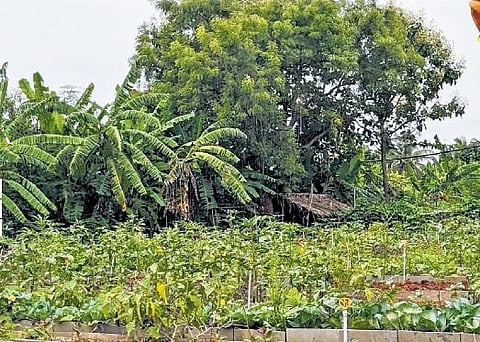
This can be better understood from the vegetable R&D centre. “Our methodology is that across a 1-acre (42,000sqft) plot of land, we have set aside 12,000sqft for cultivation, while 8,000sqft is dedicated to walking paths. The rest is an area for biomass generation, for composting.
The idea is to improve farmers’ monthly income to Rs 1 lakh/acre. This requires proper crop planning, low investment and border crops, including banana, papaya, curry leaf and lime. Border crops act as a bio-fence around the field, arresting wind,” says Manjappa Honnappanavar, Manager (Talent Engagement & Development and Commodity) at Akshayakalpa.
There are patches of vegetables and greens, including radish, brinjal, cabbage, drumstick, okra, mint and tomato, watered by sprinkler irrigation. There are 26 crops under cultivation at any given time. This system has been integrated by farmers in their lands as well.
A short drive from the R&D centre brings one to Siddalingaswamy’s 10-acre farm at Mavinakere in Tiptur taluk. Assisted by his wife, this 38-year-old graduate has taken to agriculture based on Akshayakalpa’s systems. His 20 cows generate 1,000 litres of slurry a day, apart from 185 litres of milk. “The learnings from Akshayakalpa have ensured that my animals are disease-free and my dairy business is running smoothly. Today, I grow drumstick, papaya, banana and black pepper, since I am able to generate my own slurry – a much-needed natural fertiliser,” he says.
This diversification of produce has not only improved the quality of life for these farmers, who together cultivate 6,000 acres of land, but has also redefined ‘organic farming’. Related activities, such as bee-keeping and backyard poultry farming, have ensured a steady supply of honey and eggs, all of which are packaged and retailed by Akshayakalpa, in turn bringing income to these farmers, who have found greener pastures in their own lands.
Diversified portfolio
Today, Akshayakalpa’s product portfolio, which began with milk, includes ghee, curd, paneer and other dairy products, derived using organic farming methods. The brand has diversified into non-dairy products such as batter, breads, honey, coconuts, and eggs, apart from a host of greens and vegetables like spinach, tomato, chilli, okra, mango, and banana. These are retailed via ecommerce platforms, stores, and food delivery apps
Consumer education programme
Akshayakalpa runs a consumer education programme, where its customers can visit and stay overnight at the farms it works with, and see for themselves how their food is organically produced. The sole purpose of this programme, which is free of cost, is to get customers to connect with their food. Also, the company recycles milk packets, which are returned by customers
Farmers’ friend
Akshayakalpa farmers are provided training and technical support to help them adopt organic farming practices. The company also offers fair prices for the milk produced by its farmers and provides them access to market information. The company has tie-ups with financial institutions to provide loans to them. Other services such as veterinary treatments, seed and sapling procurement, fodder slips, setting up of an open paddock system, assistance in setting up integrated farming activities like bee-keeping, poultry, raised beds, and vegetable gardens are also provided