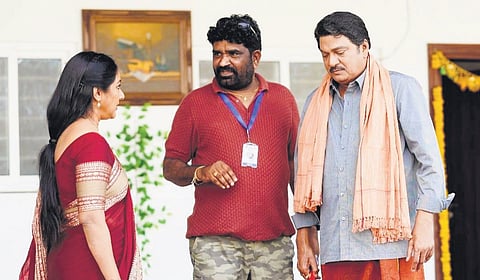

KARIMNAGAR: While marriages form an integral part of the foundation of Indian society and give it structure, weddings are often mired with a myriad of complexities. The family dynamics at play, the pomp and show and the burden to uphold societal values and expectations, among many other things, set the stage for a mega spectacle. This, and a little more, is what director and writer Ramesh Cheppala intends to show through his latest venture Laggam.
While the movie is set in the quaint expanse of Kamareddy, Ramesh hopes Laggam, set to release in August, resonates with the audience. The songs for the Rajendra Prasad-starrer were released on June 21. Speaking to TNIE, he says, “A wedding in the offing often consumes the mind of all the family members involved. Through this family entertainer, I aim to showcase the rich Telangana wedding culture and traditions.”
The customs of the hinterland and the people’s special connection to the institution of marriage often get lost in the fanfare surrounding a movie and its stars. Ramesh hopes to correct this and bring the local flavour into his art. “While weddings are, more or less, similar throughout the country, special customs and practices — like how a groom is welcomed in weddings in Telangana — are different and I hope to celebrate our differences in the film,” the writer-directors shares.
Adding to the movie’s emphasis on local traditions, Ramesh says that though weddings are becoming an object to be “get done with as fast as possible”, there has been a focus on traditions and rituals in Telangana weddings. “Instead of a function hall, a wedding used to be held outside the bride’s house. People of the family along with neighbours and relatives would erect tents and share the load of arrangements. The family head usually had a critical role to play too,” he adds.
The director says Laggam aspires to capture the celebration and the customs that make a wedding an event of a lifetime. “The baraat (wedding procession), the tension between families and the eventual compromises are part of weddings. Even the process of inviting people and distributing cards is given much importance in our culture and is shown separately in the movie,” he mentions, adding that he hopes that Laggam can convince the youth of today to get married as per local tradition and culture.
Often, the best stories have an element of universal truth. Ramesh’s inspiration has been his life in Kanaparthi village in Veenavanka mandal. “I still feel deeply connected to my native village even though it has been years since I lived here. The memories of my life here, studying here in Veenavanka and Huzurabad, before moving to Hyderabad, are still fresh in my mind. This is where I learnt almost everything I know, including the art of telling stories through the silver screen,” he adds.
With a passion for stories, Ramesh says it is writing novels that pushed him to movies. Both his movies as director — Bewars and Bheemadevarapally Branchi — have presented his take on the different aspects of family life and garnered the appreciation of film lovers. However, it was winning the Nandi Award for writing dialogues for Mee Sreyobhilashi in 2007 that turned his life around, the writer-director shares.
Not just that, he also received appreciation from former vice-president M Venkaiah Naidu for his novel Maa Kanaparthi Mushaira. In the near future, Ramesh says he is set to direct a pan-India movie Sarpanch. This apart, the rights for his novel, Bombay Doll, have reportedly been acquired by Suren, an associate of famous Bollywood director Sanjay Leela Bhansali.
