
ASSAM: As a BSc (IT) student, Chandan Borthakur sparked schoolchildren’s interest in astronomy. Today, the 38-year-old has gone way beyond his science degree by helping farmers reach the stars. His NGO ‘APRINS’ manages 50 farmer producer organisations (FPOs) in agriculture and allied sectors.
In 2009, when most 20-year-olds were busy adjusting to college life, Borthakur, then a first-year BSc student at Jorhat Science College in Assam, took a decision that would quietly but steadily transform thousands of rural lives across the state and beyond. From Jorhat, he founded his organisation APRINS with a simple yet powerful belief: real change must begin at the grassroots, not just in policy rooms.
Between 2009 and 2015, Borthakur worked with rural youth in different parts of Assam, taking astronomy classes for schoolchildren, organising skill development training programmes, and facilitating workshops for competitive exams. Working under programmes of the Indian Institute of Entrepreneurship, APRINS also trained rural youth in trades such as patient care assistance, hospitality and retail management. Around 5,000 youths—many from villages, and a large number of them women, and members of SC and ST communities—were trained and placed in hotels, hospitals, and shopping malls across the Northeast.

“The motivation behind APRINS was rooted in what I saw around me—unemployment among rural youth, low and uncertain farm incomes, and a lack of sustainable livelihood opportunities for economically weaker communities. Instead of waiting to graduate or pursue a conventional career, I chose to act,” says Borthakur.
From 2015 to 2019, APRINS shifted its focus to livelihood generation. Working with the Directorate of Dairy Development, Assam, it helped form 120 dairy cooperative societies across 11 districts of Assam. “These cooperatives provided rural households with regular income, technical support, and collective bargaining power—key ingredients often missing in individual farming efforts,” he says.
Parallelly, he adds, APRINS trained nearly 10,000 rural youth for recruitment into Assam Police and defence services. Training covered both physical preparation and written examinations, enabling many young men and women from remote areas to secure jobs. From 2019 onwards, APRINS has been involved in projects with central government agencies and national institutions like Small Farmers’ Agri-Business Consortium Society and NBARD, among others.
One of its most significant roles has been under the Centre’s flagship scheme for the formation and promotion of 10,000 FPOs. APRINS has promoted 50 FPOs, and more than 100 Fish Farmer Producer Organizations/Existing Primary Fishery Cooperatives under the Pradhan Mantri Matsya Sampada Yojana.
“Our approach remains deeply hands-on. Teams travel to villages, hold face-to-face meetings with farmers, listen to their concerns and explain how collective enterprises can reduce dependence on middlemen,” Borthakur says. Training and handholding are central—APRINS’ in-house experts guide boards of directors, CEOs and members on governance, accounting, business planning and market access. Rather than supplying machinery directly, the organisation connects farmer groups to government schemes for tractors, harvesters and processing units.
The impact is tangible. After engagement of three years, farmer incomes typically rise by 15-20%, driven by better prices, reduced wastage, diversification into products like honey and millets, and collective marketing. APRINS has also worked on branding and market linkages, helping farmer groups sell packaged rice, tea, honey and other products in formal and institutional markets.
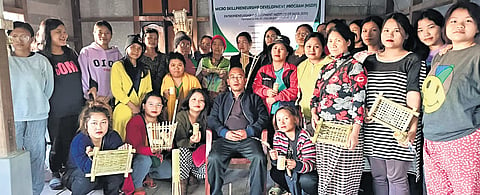
APRINS has also developed handloom and handicraft clusters involving over 1,500 women weavers, promoted scientific beekeeping with NECTAR, and established a common facility centre in Mizoram.
Over 100 people are directly employed in APRINS. One of them is Borthakur’s wife Urmimala Mahanta. A master of computer application, she quit a cushy Assam government job to work with him. Borthakur says he has reached this far due to her support.
“We had a humble beginning in Jorhat, yet we managed to spread to Mizoram, Manipur, Tripura, Arunachal Pradesh, Meghalaya besides Uttar Pradesh, Rajasthan and Telangana. Today, APRINS works with more than 30,000 farmers, has skilled over 5,000 women, and impacted the lives of over 60,000 rural citizens,” says Borthakur, expressing gratitude to his college friends who had constantly motivated him.
Looking ahead, APRINS aims to deepen its work with FPOs, expand sustainable livelihoods, and continue empowering women and youth. For Borthakur, the journey is rooted in the belief that real change begins on the ground—one village at a time.