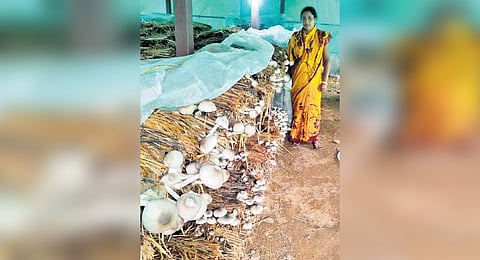

ROURKELA: Mushrooms and vermicompost can drive a village towards prosperity. It may sound strange to many but at Phuldhudi village in Tangarpali block of Sundargarh district, this is a reality with women at the centre of the change from poverty to prosperity.
Phuldhudi village has 63 families and women of all the families are into production and marketing of mushrooms and vermicompost. Ketaki Kalo is one among them. Her family owns four acre of farmland on which they grew paddy and vegetables once in a year. The crops, though, were not enough to sustain the Kalo family and educate her two children.
The year 2019 was a turning point in her life when she began mushroom cultivation with some SHG members of the village. Later on, she started growing mushrooms on her own and also ventured into vermicomposting in 2022. “Since 2022, I am earning more than Rs 2 lakh annually from mushroom cultivation and vermicomposting. And paddy, vegetable and fish farming fetches another Rs 1.5 lakh,” she said.
The change for Ketaki and other women began with implementation of the Odisha Forestry Sector Development Project (OFSDP)-II by the Sundargarh forest division in 2018. Under this, 20 members of Maa Sarala and Om Nama Shivay women SHGs of the village were given capacity-building training in mushroom farming, besides being provided with inputs.
These members worked collectively for two years and then started individually as returns for each were not attractive after sharing of profits among all members. After capacity-building, most of the women began their own ventures in paddy straw mushroom farming in Phuldhudi. Their success was an example for other women in the area to emulate.

The government helped them with different schemes on convergence mode. In 2022, vermicompost training was provided to them under OFSDP-II. The Krishi Vigyan Kendra-1 (KVK-1) at Krei stepped in to adopt Phuldhudi as a model village and extend advanced technical support for better outcome in mushroom cultivation and vermicomposting.
OFSDP-II subject matter specialist Gopal Chandra Shukla said between 2018 and 2021, 45 families ventured into paddy straw mushroom and oyster mushroom cultivation. By 2024, all the families had engaged themselves in vermicomposting. “Till 2018, awareness on government-sponsored livelihood programmes was low among women of Phuldhudi. They would grow crops only in monsoon and the rest of the year, they would either do household work or engage as daily wagers,” he said.
Today, most of them earn between Rs 70,000 and Rs 1.50 lakh per annum from mushroom farming and vermicomposting alone. Eight women farmers with large-scale operations are earning between Rs 2 lakh and Rs 3.5 lakh from mushroom farming and vermicomposting. From March to October, they grow paddy straw mushrooms and from November to February, oyster mushrooms.
Annually, they produce 350 quintal of mushrooms which are procured by traders from their doorsteps. Sundargarh forest division procures vermicompost from them for its own consumption and also supplies to other forest divisions and government agencies between July and September. Last year, it had supplied 2,130 quintal. The focus is now on capacity-building of the women in the integrated farming system.
KVK-1 head Laxmipriya Pradhan said the enterprising spirit of the women farmers has transformed Phuldhudi into a unique economic model and inspiration for others.