
BHUBANESWAR: In a major boost to tiger reintroduction plans for Satkosia Tiger Reserve, families living inside the protected area have started coming forward to relocate, accepting the state government’s compensation and rehabilitation packages under the voluntary relocation scheme.
The initiative, aimed at reducing human-wildlife conflict and restoring the natural habitat for tiger reintroduction, has received unprecedented support from villagers in recent times.
The Forest department, as part of its village relocation programme, has already relocated 78 families from Raigoda, 121 from Katrang, 262 from Tulka, 88 from Asanbahal and 125 from Bhrukundi between 2017 and 2023.
The relocation of families from Gopalpur and Tikarpada is currently underway. Around 121 out of 134 families in Gopalpur and 132 out of 152 families in Tikarpada have already relocated voluntarily during the ongoing drive.
In a major sign of encouragement, around 1,000 more families from four adjoining villages of the tiger reserve have now come forward for voluntary relocation. About 400 families from Purunakote, 250 from Chhotkei, 150 from Salor and 200 from Majhipada have agreed to relocate and submitted their consent, a senior forest officer said.
“This is encouraging since we are witnessing large-scale voluntary participation, where villagers from forest-fringe areas have realised the long-term benefits of living outside the core area,” said Principal Chief Conservator of Forests (Wildlife)-cum-Chief Wildlife Warden (CWW) Prem Kumar Jha. “The relocation is strictly voluntary and accepted only after obtaining consent from those willing to move outside the protected area,” he added.

Decade-long Challenge
When the process for rationalisation of the Satkosia Gorge Sanctuary and Tiger Reserve boundary was initiated a decade ago for tiger reintroduction, a major hurdle was the presence of numerous villages within the sanctuary area. These villages also lacked basic amenities due to restrictions imposed under the Wildlife (Protection) Act, 1972.
As part of the exercise, 104 villages covering an area of 186.96 sq km were excluded, while 359.79 sq km of contiguous forest area from adjoining forest divisions were included in the tiger reserve, based on proposals from district collectors and the recommendation of the National Board for Wildlife (NBWL).
The boundary rationalisation expanded the area of the tiger reserve from 963.87 sq km to 1,136.70 sq km. However, 31 villages continued to remain inside the protected area. Although these villages were technically ring-fenced out of the reserve, they geographically remained part of the tiger habitat, contributing to continued anthropogenic pressure on the landscape.
The high degree of human pressure and conflict arising from these settlements could neither be avoided nor ignored. Accordingly, the Forest department explored village relocation as an alternative — both to improve the living conditions of the communities and to create more inviolate space for reviving the tiger population in the reserve, where India’s first big cat translocation project in 2018 had failed on several fronts.
Convincing the Villagers
However, executing the relocation plan was not easy, said Saroj Kumar Panda, who served as the Divisional Forest Officer (DFO) of the Satkosia Wildlife Division for over three years and played a key role in pushing the initiative. The biggest challenge for the field staff was to convince people about the benefits of relocation.
“We observed that more than 80 per cent of those who had settled in the area for generations were interested in voluntary relocation. They had faced loss of life and property due to human-wildlife conflict and were deprived of basic amenities such as healthcare and education for their children,” Panda added.
The voluntary relocation of villages in the tiger reserve began in 2017, when around 78 families from Raigoda — a village located in the core of Satkosia — were shifted and resettled at a place named ‘New Raigoda’. Each relocated household received Rs 10 lakh in compensation, along with housing and other basic facilities through convergence schemes, as per the guidelines of the National Tiger Conservation Authority (NTCA) and state government provisions.
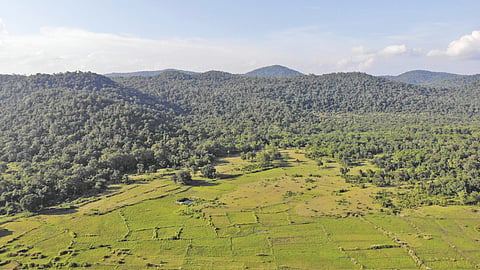
Following relocation, an area of 82.40 hectares was added to the Satkosia core as inviolate space, later developed as grassland for herbivores.
Enhanced Benefits, Better Outcomes
To encourage further relocation, the state government in 2016 enhanced the benefits offered to each family. Apart from Rs 10 lakh as ex gratia, each eligible household was provided additional amenities. Subsequently, in 2021, it issued a new guideline for relocation of villages situated within sanctuaries, national parks and tiger reserves — offering two options: Rs 15 lakh with subsidiary benefits or Rs 20 lakh without any.
Panda said the department continues to provide livelihood support to resettled families through training and capacity-building in activities such as goat farming and beekeeping.
Meanwhile, the relocation has started bringing significant improvements in wildlife population and habitat quality in Satkosia, helping the Forest department meet NTCA’s conditions to resume the big cat translocation programme in the landscape.
Momentum Builds
Relocation of about 1,000 families from Purunakote, Salor, Chhotkei and Majhipada is next on the agenda. Encouraged by the improved living standards of earlier beneficiaries, villagers have now submitted their consent. “Their applications are under examination and will soon be put into action,” a senior forest officer said.
The voluntary relocation efforts will continue in a phased manner to create a safe habitat for both local communities and wildlife around Satkosia.
So far, the relocation of five villages and partial relocation of two more has added around 816 hectares of inviolate space to the tiger reserve. Anthropogenic pressure and human-wildlife interference have dropped sharply in these areas, paving the way for grassland development and prey base improvement as Satkosia gears up to fulfil the conditions of the NTCA Central Committee, Panda said.
With steady community participation and expanding safe zones, Satkosia appears poised for a second attempt at bringing back the tiger — this time on firmer ground.