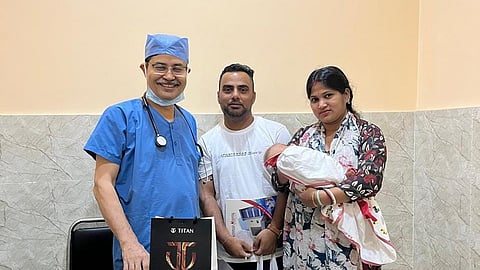

ASSAM: The nights in Kathora village in Assam’s undivided Kamrup district were once long and dark. But a young boy, barefoot and determined, managed to light them up with his hard work and willpower.
Born into a poor farmer’s family and the seventh of eight siblings, Gopal Kalita grew up without even a pair of slippers to his name. Until he passed Class 10, he went barefoot to school, to the fields, and to the riverbanks. Yet, those bare beginnings never distracted him from his studies.
Now 58, Dr Kalita is a respected gynaecologist. He completed his post-graduate medical education and built a life of dignity through perseverance. His two daughters have followed in his footsteps — the elder is a post-graduate student at AIIMS, Jammu, while the younger is pursuing her MBBS from Jorhat Medical College and Hospital. His wife, too, is a doctor, but she chose to take voluntary retirement to focus on their daughters’ education.
Kalita’s story is one of grit and quiet triumph. Despite his success, he has remained deeply connected to his roots. Whenever possible, he returns to Kathora, now in Nalbari district, to spend time with the villagers.
He remembers the hard days clearly. “My family could manage six months and struggled other times,” he says. “Kathora is a flood-prone village and the deluge greatly affects the lives and livelihoods of villagers every year.”
His father had a modest income and could barely sign his name, while his mother was illiterate. “But both knew the value of education and pushed us to study hard,” he recalls.
In his lower primary school days, Gopal and his classmates sat on rolled-up gunny sacks laid on the floor. He studied at Bishnuram Medhi High School, named after a poor peasant’s son who became Assam’s chief minister. The school was about two kilometres away, and he walked the distance barefoot every day.
“I would wake up early and go out for fishing when it was the rainy season. In other times, I would plough our field. I would return home by 9 am, get ready quickly, and rush to school. After school, I would take our cows out to graze and work in the field. This was an everyday affair till I finished school education in 1984,” Kalita says.
His discipline and determination paid off. He passed Class 10 with distinction in four subjects and went on to study at Cotton College in Guwahati, one of Assam’s most prestigious institutions. His family could barely afford his expenses, but a relative encouraged him and got him admitted.
In Guwahati, his biggest concern was paying the monthly mess fee. “A senior student, who had passed from my school, came to my rescue,” he recalls. “He approached the authorities and recommended a 50% reduction, bringing it down from `100 to `50.” “I got a pair of slippers for the first time when I went to Guwahati. One of my brothers bought it for me. A teacher of my school was kind enough to gift me a shirt and a pair of pants,” he recalls.
To support himself, he began teaching a couple of students while in Class 11. But he gave it up in Class 12 to concentrate on his studies. His efforts bore fruit — he cleared both the state medical and engineering entrance exams and chose medicine, enrolling at the Assam Medical College and Hospital (AMCH) in Dibrugarh. By then, one of his brothers had secured a government job and supported his medical education.
Kalita completed his MBBS in 1991, completed his internship, and worked briefly at AMCH before pursuing postgraduate studies at Gauhati Medical College and Hospital. He joined the government service at a state dispensary in Nalbari district in the late 1990s, but an incident there changed his path.
“I used to go to the dispensary riding a bicycle or scooter, and sometimes on foot,” he says. “One day, the road was muddy after the rains, and I was late reaching the dispensary where I was the lone doctor. A diarrhoea patient’s family members abused me for being late. The patient recovered after treatment, but the humiliation I faced stayed. I quit the job.”
A few days later, he joined a private hospital in Nalbari, where he worked for over two decades. In 2023, he and a group of doctors established a new private hospital in the town, where he now works.
Over the years, Dr. Kalita has quietly extended help to poor families — waiving consultation fees, offering discounts for treatment, and taking part in health camps across the region. Further, Kalita has often stepped in to support students.
