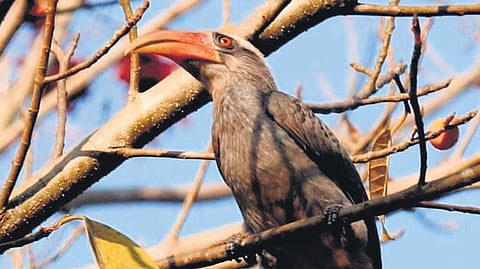

UDUPI: Malabar pied hornbills, endemic to the Western Ghats, are now being spotted frequently in Udupi city and its outskirts and in parts of Kundapur taluk. They are often seen in the backyards of houses in Udupi city and in small plantations at Vaderahobali, Koni and Basroor villages in Kundapur taluk.
With their heavy, slightly curved yellowish beaks and prominent casques, these striking birds (locally known as Mangatte) thrive in the evergreen tracts that stay damp with steady leaf-fall and rain. They can also be seen along river fronts, according to local birders.
In the wild, they eat fruits, insects and small animals. But now, according to villagers, these visitors peck at tender coconuts and arecanuts, an unusual behaviour. Bird lovers attribute this to lack of food.
“With human interventions increasing in the Western Ghats, Malabar pied hornbills could be venturing into urban areas in search of food,” said Ganesh, a wildlife photographer.
Some residents have shared pictures of these birds eating fruits grown in their gardens, Ganesh said.
“This species is largely associated with evergreen forests. But now they are being spotted in towns and cities, mainly from August onwards. Earlier, one had to travel to Dandeli to see hornbills,” Prof Laxminarayan Upadhya, an ornithologist, said.
Conservationists point to two reasons for these sightings -- shrinking forest patches and planting of more fruit-bearing saplings in urban areas. This combination might be drawing ‘Mangatte’ closer to people. For residents, close encounters with hornbills are a rare privilege, but they should remember that these birds should not disturbed during their breeding season, the birders said.

Early mornings in Udupi and Kundapur have now become a bit noisier because of shrill whistles, cackles, clucks and raucous screams of hornbills, and people rush to balconies or backyards to have a glimpse of them.
Malabar pied hornbill is endemic to the Western Ghats and protected under Schedule I of the Wildlife (Protection) Act, alongside its larger cousin, Great Pied Hornbill. That highest level of legal protection is not ornamental. It speaks volumes about this species’ dependence on big trees and forests.
They mainly eat fruits and choose natural tree cavities for nesting. After laying eggs, the female seals herself inside with a mud plaster, leaving only a narrow slit. Through that slit, the male passes food for weeks until the chicks are ready. For this ritual to happen, the nesting area should be calm and quiet, Prof Upadhya said.
A large bill with a black base and a yellow and black casque, and red eyes with dark blue bare skin around them are the unique features of a male Malabar pied hornbill. The female’s bill and casque are smaller and its eyes have white skin around them. Both have black plumage with white bellies and white patches on their wings.