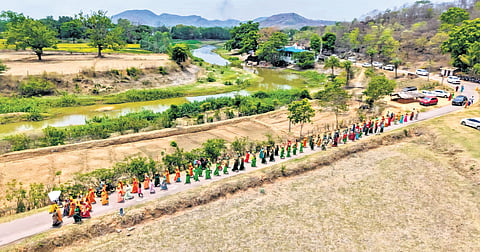

CHHATTISGARH: The mighty Mahanadi begins its journey as a humble stream at the foothills of Sihawa in Chhattisgarh’s Dhamtari district. Over the ages, it has been the region’s lifeline, nourishing fields and sustaining communities. However, neglect took its toll as time passed.
Encroachments, silt, untreated drainage, and waste choked the stream, while wild growth obstructed its natural flow. Villagers who depended on the river watched helplessly as its health declined.
That changed when the district administration launched an unprecedented effort to revive the Mahanadi at its origin. The Mahanadi Awakening Abhiyan (MAA), initiated by Dhamtari Collector Abinash Mishra, is transforming both the river and people’s relationship with it.
“Incorporating the vision of the Jal Shakti Abhiyan and our state campaign Mor Gaon, Mor Paani, we wanted to revive the river in a mission mode,” explains Mishra. “The idea was to restore the Mahanadi not just at its source, but along its 12-km stretch downstream.”
The first phase commenced on May 2, focusing on the most pressing issues across eight gram panchayats. Technical surveys and project plans were prepared with the support of Karnataka-based Mega Foundation. Within just 55 days, the drainage line was deepened, embankments were strengthened, bushes were cleared, and waste was removed. “For years, the river was in serious trouble. Now, the flow has been reactivated and organised,” the Collector said.

At the conception stage itself, community participation was made a central component of the campaign. Villagers worked alongside government staff, contributing labour and support. Usha Kiran Nag, Sarpanch of Sihawa, recalls how it made a difference: “The initiative has instilled a sense of responsibility among us. We now feel more connected to our natural surroundings. The results will benefit our future generations.”
Environmental balance and sustainability were also priorities. Over 4,000 coconut saplings were planted, and four sites were identified for check dams to regulate water flow, conserve soil, and recharge groundwater. Farmers now have improved irrigation support, and measures are in place to prevent land erosion.
The campaign has been integrated with Mor Gaon, Mor Paani, aligning water conservation with sustainable agriculture. “This campaign promotes groundwater recharge, crop diversification, and soil health,” notes Atmaram Netam, Sarpanch of Devpur.
For the people of Dhamtari, the campaign is about more than reviving a river. “With the pledge of good governance, we are safeguarding our natural heritage while sustaining life. Through the MAA campaign, Chhattisgarh is setting an example of positive change,” said Chief Minister Vishnu Deo Sai, praising the effort.
Encouraged by the success of Phase 1, the administration has already launched Phase 2, with plans to promote tourism and sustainability. Eco-tourism circuits, better infrastructure, and a massive plantation drive during the monsoon are underway. Farmers are being encouraged to adopt sustainable agriculture along the riverbanks, creating new livelihood opportunities. Forest management efforts are also being strengthened with active community involvement.
These local efforts carry wider significance as Chhattisgarh and Odisha continue to address their long-standing dispute over Mahanadi waters. The river’s vast catchment area covers 86 percent of Chhattisgarh. Its total drainage area is 53.90 percent in Chhattisgarh and 45.73 percent in Odisha. Against this backdrop, conservation at the source becomes even more meaningful.
The MAA campaign is now considered a model for source-level river conservation. Experts believe it can inspire other regions to protect their rivers at their source. For Dhamtari, it has brought hope, pride, and a renewed bond with the river that has shaped its culture for centuries.
As the Mahanadi flows cleaner and stronger than it has in years, villagers know their efforts have been worth it.
Efforts carry wider meaning
Encroachments, silt, untreated drainage, and waste choked the Mahanadi stream, while wild growth obstructed its natural flow. That changed when the district administration launched an unprecedented effort to revive the Mahanadi at its origin. The Mahanadi Awakening Abhiyan (MAA), initiated by Dhamtari Collector Abinash Mishra, is transforming both the river and people’s relationship with it. For the people of Dhamtari, the campaign is about more than reviving a river. These efforts carry wider significance as Chhattisgarh and Odisha address their dispute over Mahanadi waters.