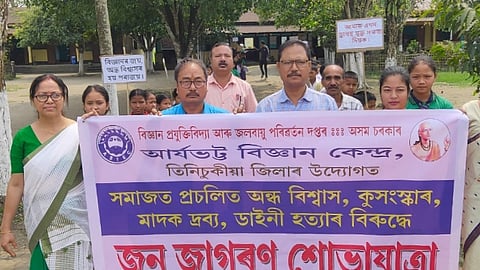

ASSAM: Diganta Bhajani has devoted himself to promoting a scientific outlook among people in Assam’s remote Tinsukia district. He is concerned about societal maladies the villagers suffer from--consulting quacks, driven by superstition, and continuing with the child marriage custom.
Bhajani, 55, teaches science and mathematics at Mechaki High School in Saikhowa. For the past five years, he has also worked to spread awareness on these issues. In 2009, the Aryabhatta Science Centre (ASC) under Assam’s Science and Technology Department engaged him to promote science education in Tinsukia. Today, he heads the district’s seven ASC blocks: Sadia, Saikhowa, Kakapathar, Hapjan, Margherita, Itakhooli, and Guijan.
During field trips, Bhajani noticed the prevalence of superstitions and child marriage. In 2021, he decided to go beyond his official duties and started working with panchayats, visiting villages to raise awareness. Using presentations and a projector, his eight-member group explained how to overcome superstition. So far, they have organised awareness camps in around 150 villages.
“People strongly believed in witchcraft. Illiteracy was the main reason. And there was none to tell them how to develop a scientific mind,” Bhajani says. Villagers would often take snakebite victims to quacks instead of hospitals. “We explained to them why they should instead take a patient to a doctor. We educated them about the common diseases, advising them to avail of treatment at a hospital or a health centre,” he adds.
He recalls a disturbing incident. A patient was admitted to a hospital, but when his condition did not improve, his family brought him home. One evening, two women he knew came to visit him. The man died the next day, and villagers blamed the women. Locals demanded punishment, but the police intervened and rescued them with help from a local student organisation.
“Resistance from people is common during our awareness drives. Sometimes, there will be arguments. They will accuse us of running a fake campaign. We use logic to clear their doubts,” Bhajani explains. He is aware of instances where individuals have attempted to acquire land by labeling the owners as witches.
“No major changes were observed in people’s behaviour, but change is palpable. It takes time to educate people and for them to adopt new ideas. After every camp, we check if there have been any changes in people’s outlook. We got to know that some people now choose a doctor over a quack,” he says. On child marriage, Bhajani points to poverty as a major cause.
“Families consider their daughters as a burden and marry them off early,” he says. Child marriage is common among school dropouts, and their group works mostly with their families. There are also cases of elopement involving minor school dropout girls. “The state government has introduced a stringent law against child marriage, but it has not stopped completely,” he notes.
His team visits families to explain the health, psychological, and other problems a child faces after such marriages. “We advise them to arrange the marriage of their daughter when she attains the age of 18,” he says. He adds that families dependent on daily wages, struggling to provide two square meals tend to marry off their daughters early.
“When we advise parents against it, they would say she would be able to manage herself after marriage. Most girls get married during their high school days. We have seen them entering into marriage after dropping out in Class 6,” he says.
Bhajani acknowledges a marginal improvement in the overall situation, crediting increasing awareness and the fear of legal consequences.
