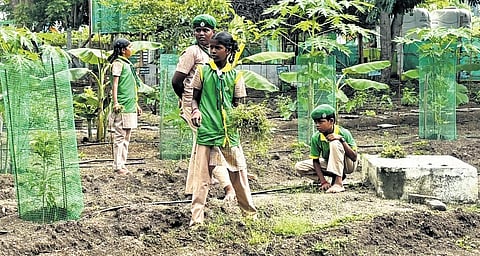

PERAMBALUR: In the sun-scorched district of Perambalur, a modest five-acre patch of land beside Valikandapuram Higher Secondary School lay unused for years. Students washed their hands in a water tank nearby, and the sullage was the only thing that reached this barren stretch. In a region known for its rich red soil and thriving paddy and sugarcane crops, the plot stood as a contradiction.
That changed in 2023 with the arrival of Dr D M Anantharaja, a science teacher from nearby Ayyalur village. It did not take long for him to recognise the untapped potential of the dormant land. He visualised the school forging a more constructive relationship with the soil. Believing the plot could act as a receptacle for the sullage, he convinced headmaster G Selvaraj to reuse the water for cultivation.
The two Ayyalur residents began on a modest scale, planting just two banana saplings. To their surprise, the plants flourished. Encouraged by this growth, the school registered with the Thesiya Pasumai Padai, also known as the National Green Corps (NGC), and 62 students signed up for organic farming in the same year.
“Under the NGC, students are divided into groups, and each takes care of specific activities such as planting, watering, composting and harvesting. We use co-curricular periods so that academics are not affected,” the headmaster said.

Dressed in distinctive green uniforms, the NGC members began utilising the land in 2023 by sowing seeds of tomatoes, brinjals, country lady’s finger, lablab beans, green chilli, pumpkin and ash gourd. “By involving students in organic farming, we aimed to connect classroom learning with real-life experience,” Anantharaja said. The response from students suggests that the effort has borne fruit.
“I never imagined that a barren patch of land could turn into a garden full of life,” said G Gokila, a Class 8 student. “Planting, watering and watching the vegetables and herbs grow has taught me patience and respect for nature. It feels wonderful to contribute to the school and see our hard work feed our friends.”
The teachers then implemented a phased development plan from 2023 to 2024 across the school grounds. It began with creating a thongum thottam (hanging garden) over 15 cents to cultivate bottle gourd, snake gourd, ridge gourd and bitter gourd. A kaaikari thottam (vegetable garden) filled another 25 cents. In the next phase, five cents of land was dedicated to herbal plants, while fruit-bearing trees such as banana, papaya and lemon covered the pazha thottam across 20 cents. Around 120 native saplings, including neem, peepal and pungam, were planted across 15 cents.
A vermicompost unit was later set up on two cents to supply organic manure for the entire cultivation. As more teachers became proactive, there were more hands on the farm.
An additional three cents of land was later dedicated to herbal plants, including Calotropis gigantea, Andrographis paniculata, Phyllanthus amarus, Justicia adhatoda and Piper longum. Name boards for each species, along with their medicinal uses, were put up for students’ learning.
During the initial days, the teachers spent money from their own pockets towards the farm. The following year, recognising the school’s commitment to sustainability, the Department of Environment and Climate Change under the Tamil Nadu Climate Change Mission selected it for the Green School Scheme (Pasumai Palli Thittam) 2024–25, enabling the sanction of funds up to `20 lakh for further environmental initiatives.
For sustained engagement, teachers inculcated farm-centred programmes. “Students now know how food is grown, the importance of soil health and the value of native plants,” the science teacher said.
Educational tours to Sathanur National Fossil Park, Ranjankudi Fort and Keezhadi have resulted in meaningful engagement with history, ecology and heritage. Nagulan, a Class 9 student and NGC captain, said the activities made learning enjoyable. “Earlier, we only read about plants in books, but now we grow them ourselves.”
Teachers also mark environmental days with awareness programmes. “What makes this project successful is collective ownership, students feel responsible for the campus. This model proves that with commitment, even rural schools can become centres of environmental leadership,” Selvaraj said.
Every time the students plant and harvest, they form a bond with the soil. Reflecting this change, Nagulan added, “Eating vegetables grown by our own hands feels special. This initiative has changed how we look at nature and inspired many of us to start small gardens at home.
(Edited by Veena)