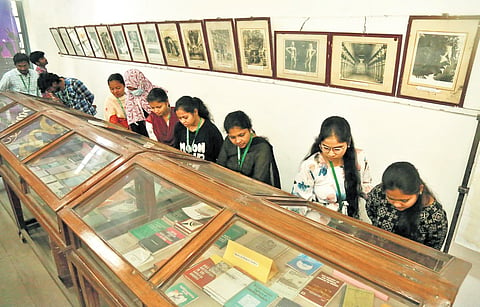

VISAKHAPATNAM: Coins, inscriptions, and ancient tools from the Telugu region tell stories of rulers, craftsmen, and everyday life at Archaeology Museum of Andhra University. Students can trace human activity here from prehistoric times to medieval period, seeing evidence of civilisation that textbooks alone cannot convey.
The museum’s numismatic collection is one of its most detailed exhibits. Satavahana silver and lead coins from Satanikota and Kotalingala reveal the economic networks and political authority of the 2nd century BCE. Vijayanagara coinage from Hampi, including those issued during Krishnadevaraya’s reign, displays motifs showing royal ideology and trade links. Qutb Shahi coins illustrate the fusion of indigenous symbols with Persian calligraphic designs.
Equally important are the copper plate inscriptions and seals preserved at the museum. The Uttaresvara Grant, Nandabalaga Plates, and Kakatiya copper plates document land grants, royal donations, and administrative regulations, often linked to specific astronomical events, providing insight into governance and social organisation. Seals, such as those with the legend Daya-Gaja-Kesari, help identify dynastic affiliations and corroborate numismatic evidence, bridging archaeology with epigraphy.
Prehistoric tools provide a tangible link to early human occupation. The collection includes Paleolithic hand-axes, scrapers, and microliths, Mesolithic implements, and Neolithic pottery, found in river basins across Andhra. The museum also preserves examples of Northern Black Polished Ware, Painted Grey Ware, Red-and-Black Ware, Andhra Ware, and Russet Coated Painted Ware, along with Pre-Harappan, Harappan, and Post-Harappan Chalcolithic artefacts. These items chart technological and cultural evolution over thousands of years.
The evolution of the Telugu script is presented through chronological epigraphy. Brahmi inscriptions give way to Kadamba and Chalukya scripts, followed by the rounded letters of the medieval period, adapted for palm-leaf manuscripts. Architectural drawings and photographs further document structural changes, from Buddhist stupas at Amaravati and Nagarjunakonda to temple architecture of the Kakatiya and Vijayanagara periods, showing continuity and adaptation in artistic traditions.
S Sitaramaraju, guest faculty member and full-time research scholar in the department, said the museum exists primarily to provide students with direct exposure to original sources. He explained that no classroom explanation can replace the clarity that comes from seeing an artefact firsthand.
