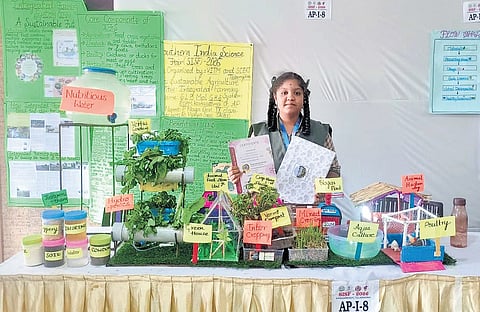

AMALAPURAM: The Sustainable Agriculture project supports small-scale farmers in villages and promotes women’s empowerment. It was developed by a 9th-class student from Sri Lal Bahadur Shastri Municipal Girls High School, Ramachandrapuram of Ambedkar Konaseema district. The student created the project by the name of “Integrated Farming System” with guidance from her teachers, G Sridevi (Physical Science) and B Vijaya Sree (Biological Science). The project gained a special prize at the South India Science Fair (SISF) - 2026 which was held at Sangareddy district in Telangana.
With a small area and low investment, farmers can integrate multiple activities like agriculture, aquaculture, vertical gardening without pesticides or chemicals, and poultry and dairy farming. Any farmer or woman with one acre of farmland can turn it into a successful business with multiple activities. They will have to invest a low budget in a poultry farm and a fish pond. According to the project, the poultry farm must be built 10 feet high. A pond must be constructed under the poultry shed for fish cultivation. Nearby the poultry farm, a cattle shed must be constructed and a biogas plant must be built on the land to produce biogas. The plant will also produce manure, which can be used as organic fertiliser.

The project enables these activities to support one another simultaneously. Poultry manure serves as feed for fish, and water from the fish pond helps agricultural and horticultural plants through the nitrification process. Waste from agricultural and horticultural crops feeds the animals and their dung helps produce biogas. The biogas manure is then used as fertiliser for vertical and mixed gardening.
Many farmers face troubles with one crop or one activity, ultimately unable to earn the money they expect. This is because they depend on single-crop cultivation and invest more in chemicals and fertilisers, said guide teacher B Vijaya Sree. The Integrated Farming System reduces additional expenses and produces healthy foods, she stated. This type of cultivation promotes biodiversity, village sustainability, farmer and women’s empowerment, and protection of soil and public health. For such projects, the central and state governments should provide subsidies to encourage village empowerment. The project costs `2 lakh to `5 lakh for an acre of land on average.