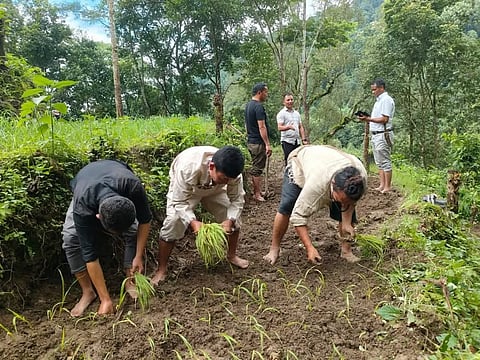

SIKKIM: When others hurried toward hybrid and cash crops for a quicker income, Tshering Gyatso Lepcha chose the uncertain and risky path of millet farming. Three decades on, this Sikkim progressive farmer is today not only preserving and promoting this heritage crop but also inspiring people across the state to earn a livelihood by cultivating what they traditionally have.
Lepcha (50) took to millet farming at a time when there was neither a market nor institutional support. His efforts went unnoticed for years until he attained virtual stardom when the United Nations General Assembly declared 2023 as the International Year of Millets.
After the declaration, the central government laid a proactive and multi-sectoral focus on millets, prompting the Sikkim government to turn its attention to this crop. Soon, it discovered that one man in the state had, in fact, already done the groundwork. The discovery led to a collaboration.
Born into a farmer’s family in the serene Lum village located in the Dzongu region of North Sikkim, Lepcha discontinued his education after Class 10 and served as the ‘sarpanch’ of his village for four terms. Alongside fulfilling this responsibility, he worked in his farmland, with an initial focus on large cardamom, but a sudden disease outbreak wiped out his crops.
“After suffering losses, I shifted my focus to indigenous millet varieties. Over time, I established a seed bank on finding people slowly shifting to hybrid crops. I thought I should do something to save our indigenous crops—rice, corn, millet. Millet did not have a market then and very few people grew it,” says Lepcha.
For generations, millet has been his family’s staple, cultivated by his parents and grandparents. When he was more or less stable financially with his millet farming, he began distributing seeds to a section of farmers, free of charge, and raising awareness among villagers on the indigenous crops. He has 14 local millet varieties. Inspired by him, a lot of farmers in the state turned to millet.
“There were discussions in Sikkim when 2023 was declared as the Year of Millets. Government departments got together in raising awareness. After a survey, they contacted me and invited me to exhibitions that were locally held. They also started sending me to exhibitions and expos outside Sikkim. Soon, I earned the ‘Millet Man of Sikkim’ moniker from the media,” says Lepcha.
He has visited villages across the state as a resource person and spread awareness on millet’s farming and preservation.
“My focus all along has been on indigenous millets, corn and vegetables. Nobody paid attention to them earlier and they were slowly disappearing. I worked to save them. Our indigenous crops have high nutritional values,” says Lepcha.
Those days, he advised local government officials to work for the preservation of indigenous crops but received a lukewarm response. Eventually, they understood his viewpoint and he started getting some kind of recognition. Millet is consumed both as chapati and rice in Sikkim, and its demand soared since 2023. Highly nutritious, its regular consumption helps manage blood sugar, boosts heart health, improves digestion and aids weight loss.

“Universities and departments approach me for the seeds. They distribute them to farmers and create demonstration plots. I recently received an order from a horticulture university for 5 quintals of seeds. I have only indigenous varieties and not genetic or modified crops,” says Lepcha.
He annually gets a harvest of 15 to 20 quintals of millet. He keeps a part of it for consumption and for the seed bank. The rest is sold off to local markets. He says he has not been able to fulfil the “huge” local demand.
“But I get only 30% of what I grow. The remaining 70% is eaten by birds, rats and squirrels. This is why, farmers stopped millet farming earlier. We talk about saving our flora and fauna but we least care for the birds. If we stop farming, they will slowly disappear. Birds don’t eat hybrid crops,” Lepcha says.
He grows his crops on a 5-hectare land with the twin aim of saving indigenous crops and nature – birds particularly. According to him, crops available in the market have 10 to 15 per cent medicinal values but indigenous crops have 100 per cent health benefits.
“We all must eat seasonal food to get protein, calcium, vitamin round the year. I have always advised farmers to not shift from organic indigenous crops to hybrid crops,” says Lepcha. “When Sikkim was moving toward becoming an organic state, I said we must also have organic seeds,” he adds.
He has spread awareness to thousands of people, including farmers and students, on indigenous crops.