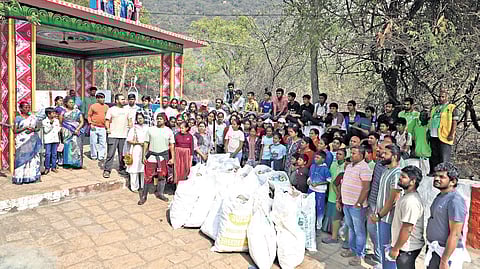

COIMBATORE: Picture this: a lone volunteer amidst hundreds of devotees, stick in hand, battling thorns and sweat on the steep steps of Marudhamalai after Thaipoosam. He extracts a discarded plastic bottle from a bush, oblivious to the scrapes on his skin and clothes. Watching intently, a young schoolgirl turns to her father, who had just tossed waste nearby, and warns him. She darts over, retrieves the litter, and drops it in a bin with a triumphant smile. In that moment, a seed of environmental consciousness is sown, sparked by quiet heroism amid the throng of devotees.
This captures the ripple effect of the Velliangiri Malai Pathukappu Amaippu, a Coimbatore-based volunteer group turning the tide against pollution on Tamil Nadu’s most revered peaks. While most cleanups target urban dumpsites, polluted lakes, or lowlands, this group’s bold focus sets them apart on sacred mountains like the ‘South Kailash’ Velliangiri Hills, where lakhs trek annually for darshan of Lord Velliangiri Aandavar, especially from February to May and during Shivaratri. Devotees often leave behind plastic bottles, wrappers, and single-use bags – threats that fester in rock crevices, streams, and plateaus.
This group has successfully inspired a collective mission from Coimbatore to Chennai, Bengaluru, Puducherry, Tiruvannamalai, and beyond. Founder P Sivaganesh, a textile businessman, explains the vision. “Plenty of people clean the plains. But mountains that hold both deep spiritual value and critical ecological importance need attention too. Protecting them is essential to safeguard the entire surrounding ecosystem. Very few step forward for this tough work; that is why we chose to take it on.”

What started informally a few years ago formalised into an association about a year back. Over 300 volunteers – including IT professionals, students, businesspeople, and UPSC aspirants – power the initiative, roughly 100 active members climb relentlessly. Efforts have expanded from Velliangiri’s seven Western Ghats hills to Othimalai near Annur, Marudhamalai, Erode’s Chennimalai, Melmudi, Perumalmudi, and Tiruvannamalai.
Climbing Velliangiri is challenging, as the forest department mandates medical checks and warnings of health risks before the trek. association secretary K Prakash details the ordeal. “In this tough terrain, volunteers climb, collect plastic waste, and carry heavy loads back down to the foothills. Only those with heartfelt commitment towards protecting nature can sustain this effort,” said Prakash. “Before each trek, they collect volunteers’ Aadhaar details, photos, emergency contacts, etc., and submit them to the forest department. It helps during emergencies. Only medically fit participants are allowed. Treks start early from the foothills, covering up to 7 km, but the steepness, terrain, and load make it feel so much longer. The temple administration handles cleaning on the seventh hill, so the team focuses on the first six hills where there are scouring plateaus, rock crevices, streams, and paths for plastic waste litter. We often face leeches, insects, wildlife encounters, fatigue, and harsh weather, yet with the support of the Forest Department we complete the task,” he added.
Sivaganesh highlights Velliangiri’s uniqueness. “It is not an ordinary mountain range, and its seven hills form a key part of the Western Ghats. Rich in biodiversity, wildlife, and natural springs, it is both challenging and sacred. With lakhs of pilgrims, especially around Shivratri, come heavy traffic that naturally leads to waste accumulation. If unchecked, no one will remove them, and obviously it becomes a severe threat to the entire ecosystem. Until every individual develops this consciousness, it’s our duty to keep going.”
Year-round sites like Marudhamalai see daily waste buildup, unlike Velliangiri’s seasonal excess. “Recently, after Thaipoosam at Marudhamalai, tonnes of plastic waste accumulated, prompting focused efforts there. We are now working at Marudhamalai with the support of local NGOs and college students. During Velliangiri’s season, teams also work at the foothills to prevent pilgrims from carrying prohibited plastics uphill. Local volunteers handle cleanup at other sites,” said S Shri Hari, a UPSC aspirant and an active member of the association.
Sivaganesh fuels the drive personally, supplying shoes, gear, meals, and essentials. In the past year alone, the group has spent 18 weeks at Velliangiri, 12 at Marudhamalai, eight at Othimalai, 10 at Chennimalai, two each at Melmudi and Perumalmudi, and one at Tiruvannamalai.
(Edited by Divya Ramkumar)