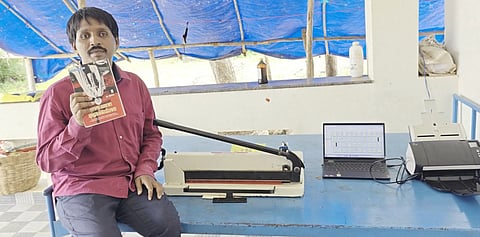

PUDUKKOTTAI: In a small classroom in Silattur, the usual yet distinct squeaking noise of chalk goes missing when a Tamil teacher steps in. Nothing against the blackboard, but for Pon Sakthivel—a visually impaired tutor—ordinary has never been the normal. As someone who battled his way through mixed ordeals, this 34-year-old dreamt of making the path a little less demanding for those next in line. Turning books accessible for those with poor vision became his calling - an inner conviction that fuels his commitment towards his community to this day.
For a majority of the visually impaired students in Tamil Nadu, reading still remains contingent on another person’s time and voice. Hit by this stark reality, Pon Sakthivel started devoting his hours to bring about a change. He converted printed books into accessible digital formats, thereby enabling visually impaired readers to read independently.
Born with visual impairment, Sakthivel, a native of Shanmuganathapuram near Alangudi in Pudukkottai district, currently teaches Tamil at the Government Higher Secondary School in Silattur near Aranthangi. Finding time beyond his classroom hours, he has digitised over 2,000 books since 2019, making them available as audio-enabled and screen-reader-friendly e-books.
Some of the books he has converted include prominent Tamil works such as the 12-volume of ‘Anandarangam’s Diaries’, the six-volume autobiography ‘Nenjukku Neethi’ by former chief minister M Karunanidhi, and Sahitya Akademi-published titles, including ‘Sirpi’s Ilakkiya Varalaru’. What makes his service even more laudable is the fact that these books were earlier inaccessible for numerous visually impaired readers in any usable format.
"When books are not available, visually impaired students are forced to depend on others. This dependence slowly affects their confidence. Education is the only resource that gives dignity to stand tall in society,” says Sakthivel, who regularly introduces and gifts new books to his students. "The world of books has helped me become a better teacher,” he adds.
Sakthivel’s mission was not born out of sympathy, instead shaped by personal experiences. After completing BA from American College in Madurai, he went on to pursue M Phil with a focus on technology for the visually impaired. In 2019, he became a teacher, and later joined for PhD at Gandhigram Rural University, on journals meant for visually impaired readers. “Throughout my learning journey, access to reading material remained a challenge,” he recalls.
After receiving a central government research grant, Sakthivel invested Rs 65,000 in a professional duplex scanner capable of scanning both sides of a page simultaneously. Thus began the printing endeavour. Once printed, the books are scanned and converted into editable digital files using Optical Character Recognition (OCR) software. These files can be read aloud using text-to-speech applications, enlarged for low-vision readers, or converted into Braille-compatible formats.
What plays an equally key role in the mission is the sourcing of books. Sakthivel makes it a point not to miss any major book fairs across the state, including those in Chennai, Madurai, Coimbatore, Erode and Tiruchy. Ahead of these fairs, he collects wishlists from visually impaired readers, students and teachers. While the readers pool in money to purchase the books, Sakthivel travels to the fairs, buys the titles, and later digitises them free of cost. "The money is collected only for buying the books. Digitisation is always done without charge," he points out.
With a steady rise in demand over the years, this young teacher has so far digitised hundreds of academic books for visually impaired teachers and students, and continues to receive requests from students preparing for competitive examinations, many of whom rely entirely on digital and audio formats.
In 2023, Sakthivel launched a WhatsApp-based initiative, ‘Viral Mozhiyin Nool Thirattu’, where members pay a nominal fee of Rs 500 and share their book wishlists, which are later purchased. At present, the group has over 20 members, who pool in around Rs 10,000 each cycle to buy books. The titles are then digitised and shared in accessible formats, and the process continues until all the selected books are read. By 2025, the group had completed 16 cycles, with several new members joining the community.
According to Sakthivel, his effort highlights the need for institutional support. Publishers should release books simultaneously in accessible digital formats, as mandated under the Rights of Persons with Disabilities Act, and government libraries and universities must invest in assistive technology, he points out, and also stresses the need for funding to set up dedicated digitisation centres so that such work is not dependent on individual efforts alone.
Despite his busy schedule, Sakthivel also finds time for his YouTube channel, where he reviews Tamil books in a single take without editing. In each session, he introduces around 15 titles, arranged alphabetically from memory, helping visually impaired readers decide what to read next.
Despite logistical challenges, including delays in book deliveries to his village, Sakthivel continues his work. As more readers gain access to books, his effort throws light on how accessible education strengthens individuals’ independence and dignity in our society.
(Edited by Arya AJ)
