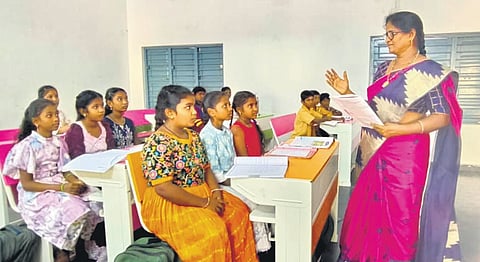

NELLORE: A government teacher has redefined teaching by transforming textbook lessons into melodies, rhythms, and poems with an innovative approach that helps students learn, and gain confidence to express themselves fearlessly.
Born on 15 January 1979 in Utukuru Kancharipalem, Vidavalur mandal, Kamanche Sarada’s life reflects perseverance, passion for literature, and a deep commitment to nurturing young minds. Known for her innovative approach, she teaches lessons through songs, rhythm and poetry. By turning textbook content into rhymes and lyrical narratives, she helps students grasp concepts effortlessly, making classrooms resonate with music and participation.
Raised in a modest family by her parents Kamanche Ravindra and Krishthamma, Sarada learnt early that education was the strongest tool to transform lives. Despite financial hardship, her parents ensured her schooling continued. Encouragement from teachers who recognised her curiosity instilled confidence that shaped her career. Her academic journey—from a village primary school to Jawahar Navodaya Vidyalaya and later an MA—strengthened her belief that learning should be creative, meaningful and joyful.
Her philosophy transformed classrooms into spaces of encouragement rather than fear. Students who once dreaded subjects began singing lessons aloud, internalising concepts without pressure.
This approach improved performance, built confidence, and enhanced communication and emotional expression. Many first-generation learners, struggling with conventional methods, found their voice through her musical teaching style. Attendance rose, results improved, and students began asking questions, composing poems and songs.
Sarada believes teaching extends beyond academics. She emphasises shaping character, values and self-belief, instilling discipline, social awareness and respect for culture and literature. She encourages students to write, sing, perform and express themselves freely. She has trained many for Hindi language examinations, helping them secure certificates that later supported employment and higher studies. For rural students, these certificates opened doors once unreachable.
Students often describe her as a mentor who believed in them when they doubted themselves. Her compassion extends into social service—distributing books, donating clothes to leprosy patients, supporting poor students with food and materials, and helping families in need. She believes education without humanity is incomplete.
Her literary talent in Telugu and Hindi has inspired students through poems and songs. She organises competitions during national festivals, motivating children to connect with culture, history and social values creatively.
Her contributions have earned her honours including the Mother Teresa State Award, Dr Sarvepalli Radhakrishnan Award, Jawaharlal Nehru Award, Nari Shakti Award, Dr B.R. Ambedkar Award, Mahila Shiromani Award, and international recognition for peace and women’s empowerment. Yet, she measures success by her students’ progress rather than accolades.
One of her most cherished moments was when students wrote poems and songs acknowledging her influence—an honour she values more than trophies.
Supported by her parents, teachers and husband Dinari Prabhakar, Sarada continues her mission at ZPHS Alimella, Indukurpeta, standing as a shining example of how creativity and compassion in education can transform lives.
