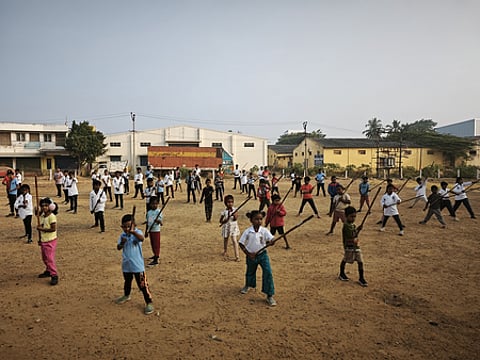

SALEM: On a crisp Sunday morning near Meyyanur in Salem, children line up, clutching silambam sticks in one hand while stretching out the other to greet their Prabhu Anna.
Prabhu Anna’s fan following is not restricted to children but also includes homemakers, working professionals, and senior citizens, who stand shoulder to shoulder, united by one common purpose—the practice of silambam, a traditional Tamil martial art.
At the heart of this community is J Prabhu, a mobile phone shop owner who has spent nearly three decades quietly nurturing this ancient craft and passing it on—without charging a single rupee.
Some paths reveal themselves only when a person is searching for some-thing else. Something similar happened with Prabhu. Having enrolled in karate classes in 1997, Prabhu’s journey was redirected after meeting a silambam master. His admiration for the art grew so deep that he switched disciplines. What began as simple curiosity soon evolved into commitment and eventually into a sense of responsibility to pass on an art form that might otherwise fadeaway.
Born in Salem in 1983, Prabhu began teaching silambam classes at a small temple in Pallapatti in 2000.The initial group was small—around 20 to 30 students—but from the outset, his classes welcomed learners of all age groups. Word spread, and schools started inviting him to train their students.
“As someone with deep love for my mother tongue-Tamil, and traditional martial arts, I wanted to pass this heritage on to the next generation,” Prabhu says.
This passion inspired him to give his group a clear identity, and the name that came to him naturally was Tamilan Silambam Payirchi Pasarai.
Today, his classes are attended by a diverse group—children as young as four, homemakers, working professionals, and even elderly people in their 60s and 70s.
One such student is a70-year-old silk thread worker, who says the classes refresh his body and mind after prolonged hours of sitting.
What truly sets Prabhu’s academy apart is its accessibility. The classes are free, with no mandatory fees. Occasionally, parents contribute a small amount, around Rs 200 to Rs 300 a month, but these funds are strictly used to buy equipment, shoes, and uniforms for students, especially those from financially challenged backgrounds.
Prabhu said the weekend classes cost around Rs 5,000 per month, while expenses exceed Rs 10,000 during competitions. There are no sponsors supporting the initiative, and he manages all the expenses using his own earnings from his shop.
Prabhu has a son and a daughter, who never bunk their dad’s classes.
At present, Tamilan Silambam Payirchi Pasarai proudly represents six locations across Salem,with nearly 500 students.
The trainers at these centres are Prabhu’s former students, now certified instructors who volunteer their time. Despite working full-time jobs, they come together on weekends to teach silambam for free.
The academy’s success is evident in its track record. Students frequently win medals in state and national competitions. At one of the School Games Federation of India (SGFI) state competitions, three students from the academy represented Salem, with two bringing home gold medals. Over 100 state-level winners have emerged from the academy.
“In a world where kids are glued to screens, these Sunday mornings keep them healthy and grounded,” Prabhu says. “The way our students handle the silambam stick, anyone can tell they belong to Tamilan Silambam Payirchi Pasarai,” he adds.
For Prabhu, preserving tradition has never been about recognition. It is about passing on a tradition and shaping a community—one disciplined movement, one shared lesson, and one respectful handshake at a time.
(Edited by Srestha Choudhury)
