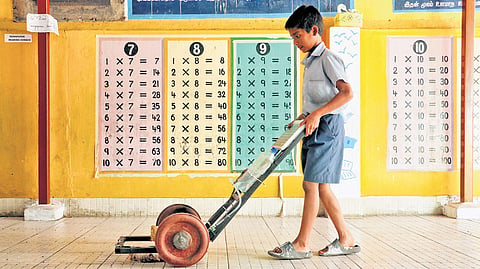

PUDUCHERRY: In the heart of Muthialpet, where the midday sun beats down on Puducherry’s bustling streets, a quiet revolution hums to life at the government primary school. A sanitary worker glides a solar-powered electric mopping machine across the classroom floors. This is not just routine cleaning; it’s the brainchild of 10-year-old M Muhammad Asif, a whiz kid whose Rs 1,000 science project has turned his school into an eco-friendly space.
The innovation which has transformed campus maintenance into an eco-friendly initiative has won top honours at the state-level science exhibition. “I used to see my mother at home and woman workers in school putting in a lot of effort to clean the floors. I heard about electric mopping machines, but they are expensive. I thought of making one at a low cost as my science project and decided to use solar power,” Asif says.
“With the help of my father, who is a welder, I made a structure using iron square pipes. I fixed an old solar panel and other parts with the support of my teachers. The total cost was just Rs 1,000,” he added.

The project won first prize at the zonal and state-level science exhibitions in the primary school category, conducted by the Department of School Education, Government of Puducherry. Asif also demonstrated the model before the Lieutenant Governor during the inauguration and received appreciation.
Headmaster S Balamurugan, the visionary steering this green shift since his appointment two years ago, has layered innovation upon innovation. “I have always been interested in making the campus eco-friendly. We decided to install solar panels to power the lights used at night. We also wanted students to learn and build such systems,” he said.
Primary school teacher K Revathy, who guided the project, said old solar panels available in the school were reused. “We purchased a battery for storage using contributions from teachers and procured other parts. We also set up a windmill model. Both were made by students with our support,” she said. The solar and windmill units together generate about 55 watts of power, which is used to light LED bulbs on the campus at night.
Beyond buzzing machines, the school nurtures life itself in a thriving herbal garden boasting nearly 50 varieties. “We received plants from the horticulture wing of JIPMER. Students were formed into teams to water and maintain the garden. Teachers monitor their work and separate attendance is maintained. Students speak about one herb every day during the morning prayer so that all learn about their uses,” Balamurugan said.
Officials from the Agriculture Department and the Government of Puducherry inspected the garden and assured support for setting up a terrace garden, praising the school’s efforts in maintaining it properly. As the momentum builds, cloth bags for students and parents to ditch plastic are next on the agenda. “I am looking for sponsors to purchase cloth bags and will soon accomplish this, as I did in the previous schools I worked at,” said Balamurugan. “Many say they do not feel like they are entering a government school because of the cleanliness and wall paintings, including in the bathrooms. If we teach primary school students the importance of being eco-friendly, they will carry it forward. It is a small step from our side for society.”
Amid the whir of student-built windmills and the names of fresh herbs recited at the morning prayer, these children aren’t just cleaning floors or tending plants; they’re planting seeds of sustainability that promise to echo far beyond Muthialpet’s gates, proving that eco-consciousness starts with one low-cost idea and a school’s unwavering belief in its young minds.
(Edited by Divya Ramkumar)