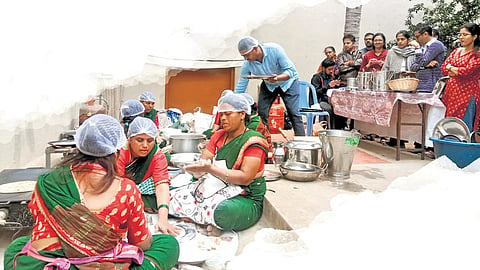

VIJAYAPURA: For nearly six hours every Sunday morning, Sumitra Halakavade stands near a hot stove preparing jowar rotis. She makes nearly 200 rotis along with other traditional dishes and the effort fetches her around Rs 10,000 every week.
Today, Sumitra earns nearly Rs 50,000 a month, with the major share of her income coming from preparing jowar rotis, the staple food of North Karnataka.
Sumitra is one among 40 women from Indi in Vijayapura district who have become part of an initiative by Wadalu Dhwani, an NGO. Most of these women were earlier working as agricultural labourers.
Every Saturday night, the women board buses from their villages to Bengaluru. They reach Gottigere early Sunday morning, where they begin preparing rotis and traditional North Karnataka dishes.
Bhuvaneshwari Kamble is the founder of Wadalu Dhwani. A resident of Vijayapura district, Bhuvaneshwari did her PhD from Karnataka State Akkamahadevi Women’s University in Vijayapura. As part of her research, she travelled extensively and interacted with rural women.
“Many women were living extremely difficult lives. They worked long hours in farms for very little money, and some migrated to other states in search of better wages, said Kamble.”
She also noticed how such struggles affected their children. “When parents migrate for work, the children’s education suffers. Many children drop out of school to support the family. That made me determined to do something meaningful for these women,” she said.
Kamble encouraged women to form Self-Help Groups where they could discuss ways to generate income. Initially, the group focused on cultivating organic crops that have a growing demand in urban markets. Later, they explored the possibility of preparing homemade edible products.

The breakthrough came during a meeting of the group.
“One of the women had grown a good quantity of groundnuts,” Kamble recalls. “Another member suggested that instead of selling the groundnuts directly, we should use them to prepare holige.”
They made Holige, a traditional sweet roti made with wheat flour, jaggery and groundnut filling, and sold it in Bengaluru. The product received a good response from customers. They also began making jowar rotis. An opportunity emerged when shopkeepers in Bengaluru suggested that the women prepare jowar rotis and sell them as part of a meal.
“At first we were unsure about the public response,” Kamble said. “So I took only five women with me during our first attempt.”
They carried flour and vegetables from their village while the organisers arranged space for cooking. What happened next surprised them.
“On the very first day, people started standing in queues to taste the food. We prepared around 200 rotis, and they were sold out before noon,” she said. Soon, more women joined the initiative. Today around 40 women from Indi are part of the group, travelling to Bengaluru every weekend to prepare and sell the traditional meal.
The women divide their work. Some prepare the rotis while others cook vegetable curries and chutneys.
Many of the ingredients come directly from their farms. “Some women grow vegetables and bring them to Bengaluru. These vegetables are also sold there and fetch good prices,” Kamble said.
The initiative has had a profound impact on the women’s confidence and independence.
Most of them had never travelled outside their district earlier. Today they travel overnight to Bengaluru, manage their cooking operations, interact with customers and return safely to their villages.
“They have learned to speak confidently with customers and even developed marketing skills,” Kamble said.
Another factor that has helped the women sustain the venture is the free bus pass scheme introduced by the government for women. It saves them nearly Rs.6,000 every month. For many of them, the earnings from just four Sundays in a month are higher than what they used to earn from working in farms for the entire week.Many apartment complexes in Bengaluru have approached the group requesting them to prepare food regularly within their residential premises. However, the group is currently unable to accept these offers due to limited manpower and time constraints.
Wadalu Dhwani now plans to expand the menu by introducing more traditional dishes that can be served fresh to customers. The organisation also hopes to involve more rural women in the project so that they too can benefit from the opportunity.
For Halakavade and dozens of women like her, the initiative has brought not only financial stability but also dignity and confidence.