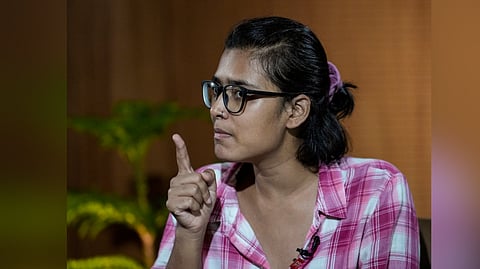

NEW DELHI: From hand-painted posters and protest libraries to catchy slogans that travelled far and wide from the Jantar Mantar, Left student organisations provided much of the visual language and organisational backbone to the month-long agitation against paper leak, AISA president Neha Bora said, arguing that the movement was the continuation of years of campus activism rather than a sudden political revival.
In an interview with PTI, Bora, a PhD scholar at the Jawaharlal Nehru University (JNU), said the participation of Left student bodies in the agitation was an "inevitable continuation" of years of protests over issues relating to education and examinations.
AISA, SFI, AISF, DISHA, Krantikari Yuva Sangathan (KYS), AIDSO, PDSU and the Agragami Chhatra Naujawan Sabha were among the Left organisations that participated in the protest, organising activities ranging from poster making and slogan writing to mock courts, makeshift libraries and cultural events during the sit-in at the Jantar Mantar.
"I think the movement against paper leak demanding accountability from the government was many years in the making. We have been protesting for several years; FIRs have been filed against our activists, we were sent to Tihar (Jail)... Be it black flag protests outside the NTA headquarters, the UGC headquarters or the Ministry of Education, we were constantly agitating," Bora said.
"The anger that had accumulated over so many years found expression through the Cockroach Janta Party (CJP). It would have been surprising had the Left organisations not joined the protest. Being part of the movement was an inevitable continuation of many years of struggle," she added.
Bora said the Left's contribution went beyond mobilisation.
"Left student bodies pushed the movement, enriched it with political narrative... we also put our lives at stake and sat on a hunger strike along with Sonam Wangchuk," said Bora, who was among three AISA activists who sat on a hunger strike at the Jantar Mantar for 23 days.
She said one of the biggest takeaways for her was the popularity of the Left's slogans and its visual campaign among the other participants.
"Our slogans and our posters were received so positively by young people. They would come to our stalls and libraries, pick up the posters and carry them. If there were 80 or 100 AISA activists at the Jantar Mantar, there were 200 to 400 people across the venue holding our posters," Bora said.
"I think what we understood from these protests is that the language of the Left, the slogans of the Left and the creativity of the Left are so popular among young people. It was wonderful to see," she added.
'We have always been here'
Rejecting suggestions that the movement represented a revival of the Left, Bora said Left organisations had consistently been at the forefront of major democratic movements over the past decade.
"We won't call it a revival because we have always been here," she said, citing the 2015 UGC protests, the movement following Rohith Vemula's institutional death, the protests after the attack on JNU, the agitation against JNU fee hike, the anti-CAA movement and the farmers' protests.
"On every democratic issue and every people's issue, you will find the Left not only fighting on the ground but also giving the movements shape, language and a political narrative," Bora said.
"Perhaps what did not happen before is the fact that Left organisations came forward in a movement so openly and undeniably. Also, we are getting such popular support because this time it was the youth who were at the forefront of the movement," she added.
According to Bora, young people connected with the Left's message because it offered hope.
"They like the language that things can change, that the world we are living in can be different and more beautiful. Young people have the courage and conviction to imagine a different world," she said.
Asked about the role of the opposition parties, Bora welcomed the support extended by the Congress, NSUI, Youth Congress and others, saying it is the responsibility of elected representatives to amplify people's movements.
She said the Left student organisations also appealed for broader coordination with non-Left groups during the agitation and had discussed strengthening the movement with the Leader of Opposition in Lok Sabha, Rahul Gandhi.
Looking ahead, she said the experience has reinforced the need for wider opposition unity. "Historically, Left organisations have always come together on different fronts. Now we also have a broader anti-BJP alliance with non-Left organisations, student bodies and political parties. This has to be the way forward," Bora said.
"We do not see electoral politics as something different from street politics. Both are important, and intervention is required at both levels. As members of AISA, it is our responsibility to ensure that this movement becomes more consolidated, that more young people become politically active and take up leadership roles on issues concerning students and ordinary people," she added.
