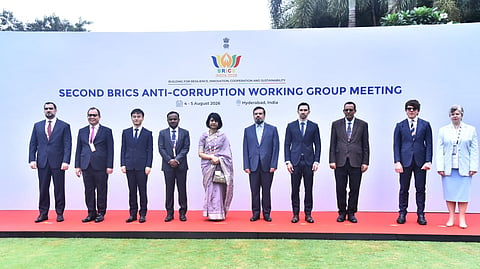

India on Tuesday pressed for greater international cooperation to trace fugitive offenders, facilitate extradition, recover stolen assets and plug loopholes that allow the cross-border movement of offenders and illicit funds.
Addressing the inaugural session of the two-day BRICS Anti-Corruption Working Group (ACWG) meeting in Hyderabad, Rachna Shah, Secretary, Department of Personnel and Training, Government of India, said that corruption remains a major obstacle to sustainable and inclusive development.
She said that corruption diverts scarce public resources away from hospitals, schools and critical infrastructure, and undermines public trust.
Underlining that no country is immune to the challenge of corruption and that no nation can overcome it alone, Shah called for collective, coordinated and sustained international cooperation to prevent illicit financial flows, safeguard public resources and strengthen the international anti-corruption architecture, according to a statement issued by the Personnel Ministry.
She said that BRICS must translate its shared mandate on tackling cross-border corruption into practical cooperation and tangible outcomes.
Highlighting the challenge posed by fugitive economic offenders, Secretary Shah stressed the need to ensure that no jurisdiction becomes a sanctuary for those who profit from crime.
She called for stronger cooperation to trace fugitive offenders, support extradition, recover stolen assets and close loopholes enabling the cross-border movement of offenders and illicit funds.
Shah welcomed the progress made on the BRICS repository on informal cooperation for tracing fugitive offenders sought for corruption and supporting extradition.
The secretary further welcomed the operationalisation of the BRICS expert network on asset recovery.
She noted that the standardised template for informal exchange of information, together with the directory of local points and practitioners, would facilitate quicker, more direct and more effective cooperation among law-enforcement agencies.
Emphasising preventive vigilance and technology-driven governance, Shah said that technology is an essential part of the solution to evolving corruption risks.
She said that digital identity, electronic service delivery, digital payments and transparent procurement systems can reduce leakages, curb discretion and strengthen public scrutiny.
Shah said that the 2nd BRICS ACWG meeting comes at a time when strengthening integrity, accountability, international cooperation and innovation has become increasingly important.
She highlighted the Government e-Marketplace (GeM), the country's national public procurement portal, and the Direct Benefit Transfer (DBT) programme as examples of technology-driven reforms.
Shah also referred to faceless and paperless systems of taxation and other public processes, technology-enabled vigilance, data-driven monitoring and stronger grievance-redressal mechanisms.
The secretary said that the side event on Ethical Governance Through Innovation and Tech-Driven Systems would provide an opportunity for members to exchange experiences on scalable vigilance practices, technology-enabled solutions and preventive oversight mechanisms.
The two-day programme, which began on Tuesday, also includes deliberations on 'ethical governance through innovation and tech-driven systems', and a session on 'emerging risks from financial technology (FinTech) and virtual digital assets (VDAs): addressing their misuse in concealing and laundering the proceeds of corruption'.
Earlier, in his opening remarks, J Ashok Kumar, BRICS ACWG Chair, welcomed the delegations and thanked them for their continued engagement, constructive contributions and collaborative spirit.
He said that the progress made in recent months reflected the value of sustained dialogue and the shared commitment of BRICS countries to strengthening anti-corruption cooperation.
Kumar said that the work during the year had focused on developing practical tools and mechanisms to strengthen cooperation among BRICS countries while ensuring that there is no duplication with existing mechanisms.
(With inputs from PTI)
