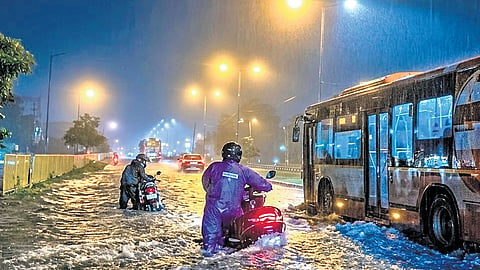

CHANDIGARH: A day after heavy rainfall threw the city into chaos, the Municipal Corporation of Gurugram is planning to install water injection wells (which are deep-bore structures that channel surface rainwater directly into underground aquifers instead of letting it pool on roads or overload stormwater drains), as it has identified four key trouble spots in the Millennium City: Subhash Chowk, Rajiv Chowk, Medanta underpass and Sheetla Mata Road, to solve the chronic flooding problem.
A one-year deadline has been set up to complete the work, and the officials have been directed to prepare a coordinated action plan and take technical inputs from IIT-Gandhinagar.
Sources said that Commissioner of Municipal Corporation of Gurugram Pradeep Dahiya held a review meeting with senior officials of the corporation and the Gurugram Metropolitan Development Authority (GMDA), along with councillors of the civic body, to finalise a technical plan for four stretches that turned into flashpoints during the downpour yesterday.
The four identified spots, which have been identified by the corporation, are being considered for these wells, with a capacity of 48 to 80 litres per second each, paired with underground water storage tanks to hold overflow before it is gradually released or absorbed.
The combined system is being designed to handle three times the volume of an actual rainfall event, giving the city a buffer against the kind of intense, short-duration downpours that have repeatedly overwhelmed its drainage network, said sources.
Unlike conventional drains that simply move rainwater sideways to a discharge point, these injection wells push it downward, thus recharging groundwater while cutting the volume that surface drains have to handle during peak rainfall.
Dahiya said this approach will mark a shift from reactive measures such as pumping and desilting, as a long-term, technology-based solution is needed for chronically flood-prone stretches.
