
CHANDIGARH: The Khap Panchayats in Haryana have called for amendments to the Hindu Marriage Act to address social issues in rural and urban areas across the state.
They have demanded that live-in relationships should not be recognised; at the time of registration of a love marriage, it should be made mandatory to inform the parents of the individuals concerned; restrictions should be imposed on marriages within the same clan (gotra), with two persons born in the same gotra being considered within the limits of the sapinda relationship; and children born in the same village should be considered brother and sister. They have also opposed increasing the legal marriage age to 21 years.
MLAs of various political parties, including the ruling BJP, main opposition Congress and Indian National Lok Dal (INLD), besides independent legislators, have been given representations by members of these panchayats and social organisations, demanding amendments to the Act.
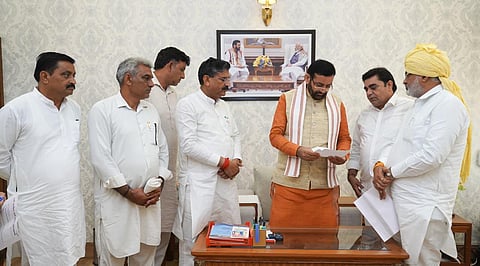
Representatives of these panchayats also recently met Haryana Chief Minister Nayab Singh Saini and submitted a memorandum in this regard.
Sanjay Deswal, chief of the Akhil Bhartiya Deswal Khap, explained the concerns during a conversation with The New Indian Express. He claimed that live-in relationships are increasingly common in both villages and cities, disrupting the social fabric.
“Every day in each of the Khap Panchayats, there are two to four cases of live-in relationships which come in, and in all cases, either the man or woman is married, or both are married and have left their respective husband and wife and are now living in a live-in relationship,” he said.
Deswal further said that marriages within the same gotra have also increased and that many such cases are coming to light, which is a worrying factor for society.
“Thus, a meeting of representatives of 300 khaps across Haryana was held at Kurukshetra from June 12 to 14, in which all these issues were discussed in detail, and it was resolved that an expert committee should be formed to legally handle these emerging concerns.
Thus, a 31-member committee was formed, which had representatives from all sections of society. Besides, they took help from legal experts and, this month, submitted a document suggesting changes in the Hindu Marriage Act,” he said.
Deswal added that on August 18, they met Haryana Chief Minister Nayab Singh Saini and submitted a memorandum in this regard. Haryana Cabinet Minister Krishan Bedi was also present. On August 22, they held a meeting with Bedi in this regard and explained their concerns in detail.
“We were given assurance that the issue will be looked into and deliberated upon and were told to meet and give letters in this regard to all the MLAs of the state across party lines, which we are giving till date. We have met 30 legislators,” he said.
Deswal said that the proposed amendments to the Hindu Marriage Act which they are seeking include the following:
“Live-in relationships should not fall under the definition of marriage and should not be recognised for any benefit or privilege for them and their children. At present, there is no such existing provision in the Act, so an addition of a new definition in Section 3 as clause (h) should be incorporated, defining the scope of live-in relationships.”
“Also, the definition of 3(g) in the Act should be broadened by inserting a sub-clause (v): Sec 3(v), thus, if two children are born in the same village, they may be considered brother and sister. Most importantly, two persons born in the same gotra will fall within the limits of the sapinda relationship, as the definition of 3(f) in the Act should be broadened by inserting a sub-clause (iii): Sec 3(iii),” he argues.
The letter written in Hindi and given to various MLAs reads:
“Family law falls under the Concurrent List of the Constitution. For the protection of the superior traditions of our society, social security, and our cultural identity, the State Government should exercise its legislative authority to enact a law amending the Hindu Marriage Act. The amendment should declare marriages between persons of the same gotra and marriages between individuals born in the same village as invalid and should make such marriages a legal offence. Persons engaging in such activities should also be declared ineligible for various rights and benefits available under the law.”
“Unfortunately, at the time of enactment of the Hindu Marriage Act, the beliefs and customs of Hindu communities, particularly those of North India, were not given due consideration. As a result, certain malpractices relating to marriage began to emerge and social values started declining. Our great traditions and beliefs have made an important contribution towards social development and social security,” states the letter.
It further added “Khap Panchayats and various social organisations have continuously been striving to protect the basic structure of society. It is therefore extremely necessary to amend the Hindu Marriage Act in order to preserve the traditions of our region concerning the sacred institution of marriage, which have been respected across the world.”
“At present, the validity of Hindu marriages is determined within a very limited definition of prohibited relationships. However, according to our traditions, people belonging to the same gotra, the same village and Guhand, meaning neighbouring or adjoining villages, have been considered members of one large family for thousands of years. Marriage among members of these groups has traditionally not been accepted. However, the Hindu Marriage Act provides legal validity contrary to these beliefs and traditions. This is viewed as an attempt to undermine our thousands-year-old way of life and customs,” it reads.
The letter states, “Throughout the world, the right of communities to preserve their beliefs and traditions is considered an important fundamental right. On the same basis, our Constitution also recognises the protection of one’s beliefs and customs as a fundamental right.”
