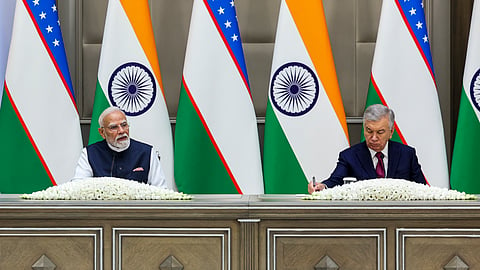

NEW DELHI: India and Uzbekistan on Sunday agreed to establish a long-term arrangement for uranium supplies from Uzbekistan to India as part of their civil nuclear cooperation, while elevating bilateral ties to a Comprehensive Strategic Partnership.
The decision was taken during talks between Prime Minister Narendra Modi and Uzbek President Shavkat Mirziyoyev in Tashkent, where the two sides also set a target of increasing annual bilateral trade to USD 5 billion by 2030.
The two sides also signed 11 agreements covering areas including trade, investment, infrastructure, critical minerals, mining, defence, pharmaceuticals, healthcare, information technology, education and digital public infrastructure.
Uranium emerged as a key new area of cooperation in the civil nuclear energy sector. During delegation-level talks, Modi said the two countries would establish a long-term arrangement for uranium supplies from Uzbekistan.
“We will also establish a long-term arrangement for the supply of uranium,” Modi said and added that India and Uzbekistan should develop a roadmap to fully realise the potential of their expanding partnership.
Secretary (West) in the MEA Sibi George later said discussions on uranium supplies had been “positive” and that the two countries were close to signing an agreement very shortly.
He said the upgraded strategic partnership would also include a Foreign Minister-level Coordination Group and raise the existing Joint Commission mechanism from the secretary level to the ministerial level.
The two leaders also placed strong emphasis on counter-terrorism.
In their joint statement, India and Uzbekistan “unequivocally condemned terrorism, including cross-border terrorism, in all its forms and manifestations” and reiterated their “zero tolerance approach” to terrorism.
The two sides called for concerted action against terrorist organisations and their financing networks, safe havens and infrastructure, while stressing that those responsible for terrorism, as well as their backers, facilitators and affiliates, must be brought to justice.
Cooperation in intelligence-sharing, law enforcement, countering violent extremism, organised crime, illicit drug trafficking and cyber threats will also be strengthened.
Defence cooperation is another area where the two countries intend to move beyond traditional exchanges. Modi said India and Uzbekistan would encourage their defence industries to establish direct linkages and pursue co-development and co-production of military equipment.
Connectivity and people-to-people ties also received a push.
Uzbekistan is set to remove visa requirements for Indian citizens for stays of up to 30 days, a move Mirziyoyev said would encourage tourism, business travel and wider people-to-people contact.
George also said Indians travelling to Uzbekistan would be able to use UPI-enabled applications in the country within a year.
Highlighting Uzbekistan’s strategic importance, Modi said: “Uzbekistan is at the heart of Central Asia and is at the heart of India's engagement in the region,” describing a stronger bilateral partnership as a “powerful force for peace, progress and prosperity in Central Asia.”
The visit also saw Modi conferred with Uzbekistan’s highest state honour. He described the recognition as a moment of “great pride” and dedicated it to the 140 crore Indians, saying it reflected the strength and growing depth of India-Uzbekistan relations.
