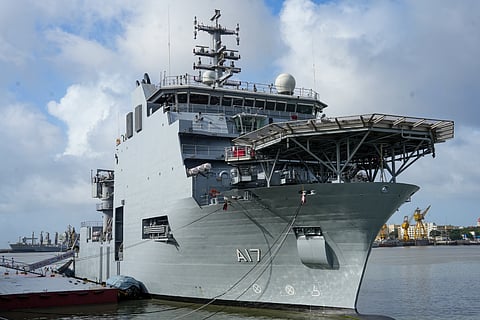

NEW DELHI: The Navy on Monday commissioned INS Nipun at the Naval Dockyard in Mumbai, giving it a dedicated deep-sea diving and submarine rescue platform on the western seaboard. The vessel can support saturation diving to 300 metres and is configured to embark and operate the Navy’s deep submergence rescue vehicle.
Nipun is the second Nistar-class ship. With Nistar based at Visakhapatnam since July last year, the Navy now has purpose-built rescue cover on both coasts.
The commissioning closes a gap that has stayed open for nearly eight years. India bought two deep submergence rescue vehicles (DSRV) systems from Britain’s JFD, inducting them at Mumbai and Visakhapatnam in 2018 and 2019 and joined the small group of navies with an integral rescue capability. But it had no dedicated mother ships to carry them. The first vehicle went to sea aboard INS Sabarmati, a vessel taken from the Shipping Corporation of India.
“Response time is the whole game in a submarine accident and the mothership is what determines it. A rescue system that has to be loaded onto a borrowed hull before sailing loses hours that trapped crews do not have,” an official explained.
Nipun’s ability to embark and operate the DSRV “expands our capacity to assist a distressed submarine”, Navy chief Admiral Krishna Swaminathan said at the commissioning ceremony, adding that this was held for partner navies as well as India’s own boats.
The DSRV is crewed by three and can lift 14 people in one sortie from a bottomed submarine, mating with the escape hatch at depths of up to 650 metres. In trials it dived to 666 metres.
The capability also adds some diplomatic weight. India moved its DSRV towards Bali in April 2021 after an ISMERLO alert on the Indonesian submarine KRI Nanggala, which was lost with 53 men. Few of the region’s submarine operators can mount a rescue of their own.
The Admiral framed the induction against a harder backdrop, saying the country was passing through a period of “significant strategic churn” and that the maritime environment was becoming more contested.
The underwater domain in the Indian Ocean is more crowded than at any point since the Cold War, with Chinese boats operating regularly in the region and neighbouring navies expanding their submarine arms.
He cautioned that commissioning was only the first step, and that success would be measured by “how rapidly and effectively we convert this new platform into deployable operational capability”.
As reported earlier, the Navy is on course to commission 18 warships this year.
