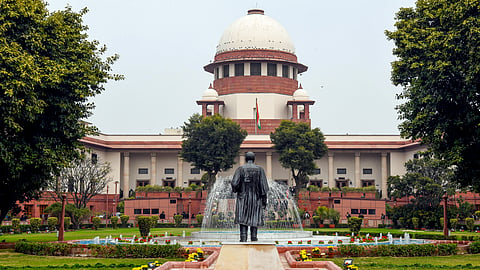

NEW DELHI: In a landmark verdict, the Supreme Court on Thursday held that the information received from a minor victim about sexual assault will be deemed credible and the recipient will be bound to report it to the authorities concerned, including police under the POCSO Act.
A bench of justices Manoj Misra and K V Viswanathan, which interpreted the question as to when can it be said that a person has knowledge that an offence under the POCSO Act has been committed, noted that the phrase “has knowledge that such an offence has been committed” is not limited to direct knowledge, but would include awareness of its commission based on direct information received from the minor victim.
“For the purposes of this Act, when a child victim reports to a person that he or she has been subjected to an offence, or is likely to be subjected to an offence punishable under the Act, it could safely be concluded that the person to whom such information is provided by the child victim has knowledge that such an offence has been committed or is likely to be committed,” the bench ruled.
The Bench said the purpose of Section 19 of the POCSO Act is to mandate reporting and build a child-friendly mechanism where a child’s statement is acted on without delay.
“Children usually share such details only with people they trust. Asking for independent proof before reporting would run contrary to the objective of the law,” the court observed.
The ruling came in an appeal where the accused claimed he did not have “knowledge” as required under Section 21 of the POCSO Act, which provides for punishment of up to six months in jail, a fine or both for anyone who fails to report an offence under the Act.
The court said when a child informs a person that an offence has been committed or is likely to be committed, the duty to report under Section 19(1) begins at once.
Also in top court
Larger bench may hear arrest validity
The SC on Thursday said it might refer to a larger bench whether a typographical error in mentioning the statutory section in an arrest memo is enough to invalidate an arrest and grant bail. The court made this observation while hearing the appeal filed by the Meghalaya government challenging the bail granted to Sonam Raghuvanshi.
Equestrian team row: Judge recuses
Supreme Court judge KV Viswanathan on Thursday recused himself from hearing a plea challenging the Delhi HC’s refusal to interfere with the non-selection of riders Anush Agarwalla and Sudipti Hajela in India’s dressage team for the upcoming Asian Games in Japan. Justice Viswanathan said he would recuse.
