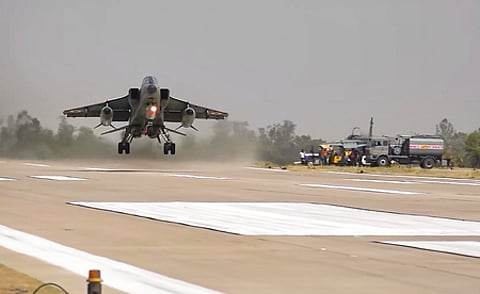

NEW DELHI: Nine retired Royal Air Force (RAF) Jaguar aircraft have been transferred to the Indian Air Force (IAF) this year to be cannibalised for spares, a UK parliamentary reply has revealed, pointing to the mounting challenge of sustaining India’s ageing deep penetration strike fleet as the world’s last operator of the Anglo-French fighter.
In a written reply to Parliament earlier this month, UK Minister for Defence Procurement and Industry Luke Pollard said nine Jaguars, comprising five single-seat GR1 strike variants and four twin-seat T2 trainers, had been transferred to the IAF since January 1, 2026.
Replying to questions from Conservative MP Ben Obese-Jecty, Pollard also said the UK still holds 42 Jaguars, including 13 GR1 aircraft, indicating more retired airframes could potentially be made available.
The aircraft, retired from RAF service in 2007 and subsequently used as instructional airframes at RAF Cosford, are not airworthy and will never fly again. Instead, they will be stripped for engines, avionics, hydraulic systems, undercarriage assemblies, ejection seat components and structural parts that will be refurbished and fitted onto operational Jaguars.
The IAF has increasingly turned to donor aircraft as production of the SEPECAT Jaguar ended in the 1980s after only 573 aircraft were built, leaving virtually no global supply chain for the fighter. France transferred 31 retired Jaguars in 2018, while Oman supplied around 20 stored aircraft last year along with Adour engines and nearly 3,500 lines of spares. India is also learnt to be exploring retired Jaguar fleets in Nigeria and Ecuador for additional components.
The fresh stock of spares comes at a critical time. Martin-Baker has indicated it can no longer supply over 250 categories of components for the Jaguar’s Mk 9 ejection seats, forcing the IAF to increasingly undertake repairs in-house.
The twin Rolls-Royce Turbomeca Adour Mk 811 engines, underpowered in India’s hot-and-high conditions and lacking Full Authority Digital Engine Control (FADEC), continue to be another weak link. A plan to re-engine the fleet with Honeywell F-125IN turbofans, offering about 30 per cent higher thrust, was abandoned in 2019 due to prohibitive costs.
Around 120 Jaguars continue to serve in six squadrons, with the upgraded DARIN III variants expected to remain in service until around 2035.
With fighter squadron strength down to 29 against the authorised 42.5, Tejas Mk1A inductions delayed and the Tejas MK2 and Advanced Medium Combat Aircraft (AMCA) still years away, the IAF has little option but to keep the Jaguars flying.
