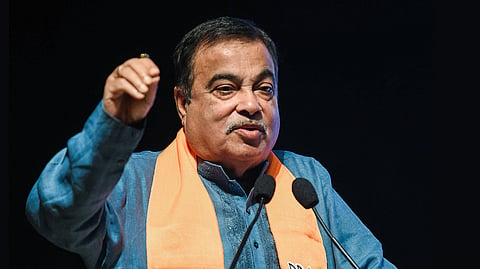

Amid severe criticism over the blending of ethanol with fuel, Union Minister of Road Transport and Highways Nitin Gadkari said that the “negative campaign” against him is sponsored by a lobby which benefits from the existing fossil fuel import ecosystem.
In an interview with TNIE's Parvez Sultan, in which he candidly spoke about personal allegations against him and the alleged theft of Ram Temple donations, the minister said he is unaffected by the criticism and is focused on reducing imports of fossil fuel, controlling pollution and making India self-reliant in the energy sector.
Excerpts from the interview:
Q. There has been significant criticism recently that E20 petrol could damage vehicles that were originally designed to run on conventional petrol. Your response.
We need to understand why we are promoting ethanol and alternative fuels. India imports fossil fuels worth around Rs 22 lakh crore every year. This money goes out of the country, while fossil fuels also contribute significantly to pollution.
My objective is to reduce imports, reduce pollution, and make India self-reliant in the energy sector. From the inception, my vision has been diversification of agriculture towards the energy and power sector. I have always spoken about alternative fuels and biofuels, not just ethanol. These include ethanol, methanol, bio-CNG, electric vehicles, and hydrogen.
Ethanol is not an experiment only limited to India. Ethanol blending is not new. Countries such as Brazil, the United States (US), Thailand, and European countries have been using ethanol for decades.
Brazil has had flex-fuel engines since 1970, where consumers have the choice to choose their ethanol blends up to 100 per cent ethanol. Before introducing ethanol blending, vehicle manufacturers and testing agencies conducted trials.
The Automotive Research Association of India (ARAI) tested vehicles, and after successful trials, the government issued notifications. New vehicles have also undergone necessary modifications, including changes in components like washers.
The vehicles running in India are manufactured by global automobile companies, and these companies follow international standards. If ethanol blending was unsafe, these companies would not support or develop ethanol-compatible vehicles.
Major automobile companies are working on ethanol-compatible vehicles and flex-fuel technology. These companies would not compromise their reputation by producing unsafe vehicles.
Four years ago, on January 26, ethanol-blended fuel was also used in our helicopters and fighter aircraft during trials. Now, ethanol is also being converted into isobutanol, which can become an alternative to diesel in the future.
Similarly, agricultural waste such as stubble, which was earlier burnt and caused pollution, is now being used to produce bio-CNG and methane through biodigesters. Methane can further be used to produce hydrogen or bio-CNG. Around 4,000 projects are being developed in Punjab and Haryana to utilise stubble. The value of crop residue has increased to around Rs 2,500 per tonne, giving farmers an additional source of income.
If farmers stop burning stubble, pollution levels in Delhi and neighbouring regions will reduce significantly, while farmers will also benefit financially. The bio-CNG produced from such waste can be used in trucks, tractors, buses, cars and other vehicles.
Q. The other claim is that despite 20 per cent ethanol blending, petrol prices have not reduced.
Petrol prices are linked to international crude oil prices. Crude prices have fluctuated significantly, rising to around US dollars 130 per barrel and later declining.
When international crude oil prices rise, maintaining the same fuel price becomes a challenge and results in losses. If crude prices decline, the benefits can be balanced accordingly.
Airlines are currently facing losses as well. The government had to provide a support package of Rs 10,000 crore and fix the aviation turbine fuel (ATF) price at Rs 115 per litre. Otherwise, the entire aviation sector would have faced a severe crisis, with companies shutting down operations.
Moreover, fuel pricing is not determined only by ethanol blending.
If ethanol-based vehicles become common, the cost advantage will increase. Ethanol is cheaper, indigenous, pollution-reducing and helps reduce dependence on imported fuel.
Q. Why have we recently seen so much criticism and negative campaigns against ethanol and you in particular?
There is a lobby that benefits from the existing fossil fuel import ecosystem, which involves thousands of crores of rupees. Some individuals and groups are deliberately spreading misinformation that ethanol damages vehicles. False claims and misleading examples are being circulated widely on social media and other platforms.
Some private entities involved in fuel imports are sponsoring this campaign to create a negative perception about ethanol and defame me.
For example, a misleading video went viral showing a petrol tank with ants around it, claiming that since ethanol is made from sugarcane, ants would be attracted to petrol blended with ethanol. This is completely illogical. Have you ever seen ants or flies gathering around a bottle of brandy, whisky or rum? Such claims are baseless and part of a misinformation campaign.
In one case, a person claimed that his Toyota vehicle had developed a problem due to ethanol. When the company inspected the vehicle, it was found that the problem was caused by adulterated fuel containing water, not ethanol.
The reality is that leading automobile manufacturers are investing in ethanol-based technologies.
Would globally respected companies introduce ethanol-compatible vehicles if the technology were unsafe?
Q. Some people allege that you personally benefit from ethanol production?
Baseless allegations. The government purchases ethanol through a tender process, and the price is decided by the Cabinet. I have no role in deciding which company gets a contract.
There are around 550 industries producing ethanol. Before the ethanol policy came in, I started a sugar factory that produced alcohol; now my sons look after it.
Making such allegations is like saying that every farmer who grows wheat and sells it in the market is benefiting from the government's food policy. My family's stake in the industry is just one per cent of total ethanol production in the country.
Q. Despite criticism, you continue to defend ethanol policy. Why?
My focus is on national interest. I am not promoting ethanol for personal benefit. I am talking about it because it benefits the country, society and farmers. I have faced criticism in politics before, but I believe people understand the truth. If a policy helps reduce imports, control pollution and improve farmers’ incomes, it should be pursued.
If this is about protecting the country’s interests, then such opposition is expected. When Mahatma Gandhi launched the Swadeshi and self-reliance movement, he encouraged people to give up foreign goods. Were those foreign products not of good quality? They were, but the question was whether India should continue importing everything or build its own capabilities.
Should our country create its own industries, provide employment to farmers, increase farmers’ income and make villages prosperous? This is the larger objective behind promoting indigenous alternatives.
I come from Vidarbha, where around 10,000 farmers have lost their lives due to agrarian distress. Today, India has a surplus in wheat, rice, corn and sugar production. In states such as Uttar Pradesh and Bihar, if ethanol had not been introduced, the sugar industry would have faced a major crisis. Who would have purchased the sugarcane produced by farmers? What would have happened to their livelihoods?
Q. What do you think will be the future of fuel? Will hydrogen, ethanol and other alternative fuels replace petrol and diesel, or will new technologies emerge?
Given the scale of our fuel consumption and dependence on imports, it is not possible to completely replace petrol and diesel immediately. It will take time. But our objective is clear to make India self-reliant in the energy sector.
We need to develop and adopt multiple technologies. Electric vehicles, ethanol, methanol, biodiesel, LNG and hydrogen will all play an important role in reducing our dependence on imported fossil fuels.
Our aim is that the Rs 22 lakh crore spent annually on fuel imports should not go out of the country. Instead, this money should benefit our farmers, create employment opportunities for our youth and strengthen the rural economy. This is the vision of a self-reliant India.
Q. The Ministry of Road Transport and Highways has planned QR codes on all future road signages. Will it help to fix accountability?
The QR code system will make highway information easily accessible to citizens. If a person travelling on a road faces any issue, they can scan the QR code and get complete information about that highway.
Earlier, people used to write complaints asking about toll plazas, facilities and other details. Now, all information will be available through a mobile phone.
People will be able to access details such as the nearest petrol pump, wayside amenities, hotels and other facilities available along the highway. The system has already started rolling out, and it will take some time to cover the entire country.
I assure you that the number of complaints will reduce significantly. This year itself, complaints will come down by around 10 per cent, and after two years, such complaints will become negligible.
Q. There have been allegations of theft of donations at the Ayodhya temple. How do you see these allegations?
I have complete faith in Champat Rai ji. He has dedicated his life to the country. However, there should always be an inquiry into any allegation, and if there are shortcomings in the system, they should be corrected. But no one from the trust can do such a thing. This is my complete faith.
Such incidents can happen in many places, including temples. The responsibility is to make systems transparent through technology.
As far as the intentions and integrity of the trustees are concerned, I have no doubt. People such as Champat Rai ji and Govind Giri Maharaj have devoted their lives to public service, and questioning their intentions is not justified. Even their enemies can speak against them.
There can be technical or procedural shortcomings, and those should be rectified. There is a difference between a bona fide mistake and a mala fide mistake. If someone deliberately commits wrongdoing, strict action should be taken.
But if there is a genuine technical or procedural error, the focus should be on correcting the system rather than blaming individuals unnecessarily.
According to me, bonafide mistakes are there. In my view, such issues should be resolved through technology and better systems rather than defaming people who have dedicated their lives to the cause.
