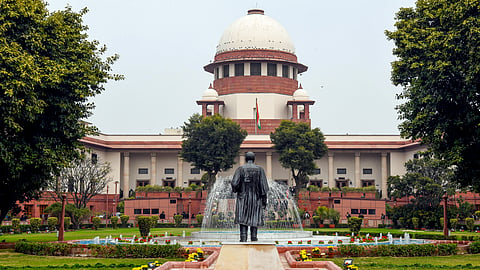

The Supreme Court on Wednesday said preventive detention orders should be passed against those facilitating illegal sand mining activities in and around the National Chambal Sanctuary as such people are eating into natural resources and deserve no sympathy.
The observation came from a bench of Justices Vikram Nath and Sandeep Mehta which was hearing a suo motu case titled 'In Re: Illegal sand mining in the National Chambal Sanctuary and threat to endangered aquatic wildlife'.
The bench was informed that in Madhya Pradesh's Morena, 551 persons, who facilitate illegal sand mining activities, have been identified.
"Why don't you detain them? These are people against whom preventive detention orders should be passed," the bench observed.
It said some of these persons should be kept under preventive detention for some time for setting an example.
"These people are eating into natural resources, destroying pristine forest areas. They don't deserve any sympathy," the bench observed, adding that preventive detention orders could act as a deterrent.
The National Chambal Sanctuary, also called the National Chambal Gharial Wildlife Sanctuary, is a 5,400-sq km tri-state protected area.
Besides the endangered gharial (long-snouted crocodile), it is home to the red-crowned roof turtle and the endangered Ganges river dolphin.
Located on the Chambal river near the tripoint of Rajasthan, Madhya Pradesh and Uttar Pradesh, the sanctuary was first declared a protected area in Madhya Pradesh in 1978 and now constitutes a long and narrow eco-reserve co-administered by the three states.
During the hearing, the bench also stressed on the need to have an institutionalised and structured scheme for welfare of frontline forest personnel, including forest guards, who are engaged in enforcement activities.
The bench was told that there were some incidents where forest guards were attacked or even killed while discharging their duty.
A law officer, appearing for one of the three states, said earlier compensation of Rs 10 lakh was given in case of death and now it has been increased to Rs 25 lakh.
He said family pension and compassionate appointment was also given to the family members of victim in such cases.
"To these people, we will provide proper solace," the bench observed, adding, "All this has to be institutionalised".
The bench was also informed about the enforcement measures taken in these three states, including the number of FIRs registered, to prevent illegal sand mining.
On the issue concerning environmental flows in Chambal river and its tributaries, the bench observed that the nature takes care of itself.
"The animals and nature take care of themselves. They don't need much intervention. The lesser the intervention, the better it is. So, let the water flow naturally and things will revive and restore on their own," it said.
The bench posted the matter for hearing on August 4.
On May 26, the top court passed a slew of directions for effective implementation of environmental and statutory safeguards in the regions affected by rampant illegal sand mining within and around the National Chambal Gharial Sanctuary.
It had asked the three states to undertake immediate and effective steps for the augmentation of field-level enforcement officials in the respective forest departments, including recruitment to vacant posts of forest guards and other frontline enforcement personnel.
The apex court had directed the states to undertake stringent, continuous and coordinated enforcement action against vehicles and machinery involved in illegal mining and transportation activities within and around the affected regions.
It had directed that appropriate criminal prosecution be initiated not merely against the drivers of vehicles involved in illegal mining and transportation activities, "but also against the owners, financiers, operators, contractors and all other persons forming part of, facilitating or otherwise connected with organised illegal mining network operating in the affected regions".
On April 17, the apex court passed a slew of directions in the matter and said these states would be well advised to invoke provisions relating to preventive detention, seizure and confiscation of immovable properties and machinery, and to undertake stringent prosecution to bring the offenders to book and ensure environment protection.
(With inputs from PTI)
