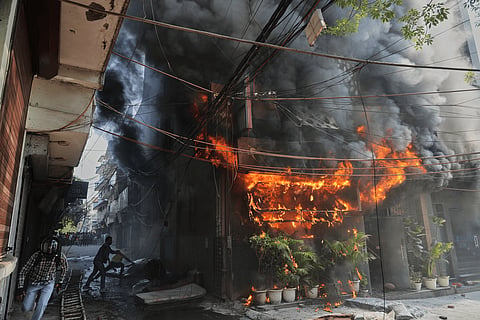

A devastating fire that ripped through a bed-and-breakfast accommodation in South Delhi's Malviya Nagar on Wednesday morning has exposed a dangerous nexus of alleged building violations, inadequate fire safety measures, regulatory lapses and delayed compliance with court-mandated safety reforms.
At least 21 people, including six foreign nationals, lost their lives in the blaze at the Flourish Stay B&B in Hauz Rani, while several others sustained serious injuries. Officials fear the death toll may rise as multiple victims remain in critical condition.
Delhi Police has arrested Lavkesh Bajaj, the owner of the hotel building. Multiple police teams were deployed to locate the hotel owner, who was absconding after the incident.
Police had earlier issued a look out circular (LOC) against Bjaja and his wife, and launched an operation to trace them.
As investigators piece together the circumstances behind one of Delhi's deadliest fire tragedies in recent years, emerging details suggest that the building had become a virtual death trap long before the fire broke out.
What happened?
The fire erupted on Wednesday morning at Flourish Stay, a bed-and-breakfast establishment operating from a five-storey building in the congested Hauz Rani locality near Malviya Nagar.
According to police sources, the incident began shortly after the chef arrived at the ground-floor restaurant and switched on equipment to begin preparations for the day. Witnesses reported hearing a blast-like sound, possibly linked to an electrical fault, before flames rapidly spread through the structure.
Within minutes, thick smoke engulfed the building, trapping dozens of guests and attendants staying inside.
Delhi Fire Services received a distress call at approximately 8:50 am and initially dispatched seven fire tenders. As the scale of the disaster became apparent, the response was expanded to 17 fire vehicles.
By the time firefighters reached the scene, smoke had filled the entire building.
Investigators and fire officials point to a combination of structural flaws and alleged violations that severely restricted escape routes.
Sealed windows left occupants trapped
According to Chief Fire Officer Abhilash Kumar Malik who spoke to news agency PTI, the building's windows had been permanently sealed.
"The building's design made escape almost impossible for the occupants. The windows had been permanently sealed, resulting in no ventilation. Such buildings act like a shaft, where heat and smoke can engulf the entire structure within seconds," he said.
Without ventilation, toxic smoke spread rapidly through the structure, suffocating occupants before they could reach safety.
Residents have alleged that the building's sensor-operated entrance gate stopped functioning after the fire broke out.
As smoke intensified and panic spread, many occupants found themselves unable to exit through the main entrance.
Several survivors reportedly remained trapped inside for extended periods because both the gate and room access systems malfunctioned amid the blaze. Police sources also said the hotel effectively had only one entry and exit point.
Fire safety experts have long warned that buildings with a single evacuation route become especially hazardous during emergencies, as occupants can quickly become trapped if the route is blocked by flames or smoke.
Smoke became the biggest hazard
Fire officials noted that the building's vertical structure, basement, ground floor and five upper storeys, acted like a chimney.
Once the fire intensified, smoke travelled upward through the building at tremendous speed, making staircases and corridors unusable within minutes.
Many victims are believed to have succumbed to smoke inhalation rather than direct burns.
One of the most serious allegations emerging from the investigation concerns the hotel's operational status.
According to fire officials, the establishment possessed a bed-and-breakfast licence permitting only six rooms.
However, authorities claim that nearly 25 to 26 rooms were being operated across multiple floors, including the basement and terrace.
Residents familiar with the building said it had functioned as a commercial hotel for years despite being licensed as a small B&B.
The ground floor housed a restaurant, while guest accommodation occupied nearly every level of the building.
Authorities are now investigating whether local licensing and civic bodies failed to detect or act against the alleged violations.
Officials have also revealed that the building allegedly did not possess a Fire No Objection Certificate (NOC).
Chief Fire Officer Malik stated that neither the building management nor licensing authorities had sought a fire clearance reference from the Delhi Fire Services.
The absence of a valid NOC raises serious questions about how a commercial accommodation facility was allowed to operate without mandatory fire safety certification.
Investigators are expected to examine whether forged, expired or non-existent clearances were involved.
Dramatic rescue efforts
As flames spread and smoke engulfed upper floors, guests resorted to desperate measures to survive.
Eyewitnesses reported seeing people smashing windows and jumping from upper storeys.
A foreign couple trapped on the fourth floor allegedly broke a window and aluminium grill before attempting to climb down using a pipe. Both reportedly fell and suffered critical injuries.
One of the most dramatic scenes involved a woman carrying a child while jumping from the building.
Local residents rushed to the scene and laid mattresses, blankets and cushions on the road below in an effort to reduce injuries from the falls.
Several neighbourhood residents used ropes, hammers and stones to break windows and assist trapped occupants before rescue teams could fully access the building.
More than 40 people were eventually rescued.
Many of those staying at the hotel were foreign nationals, particularly from Central Asian and African countries.
Authorities said several guests were relatives and attendants of patients receiving treatment at a nearby private hospital.
The presence of international visitors has added another dimension to the tragedy, with diplomatic channels likely to be involved in victim identification and repatriation processes.
Delhi Police have registered an FIR under charges of culpable homicide.
Authorities are examining possible offences including: Culpable homicide not amounting to murder, negligence causing death, violations of fire safety regulations and Illegal commercial operations. Further charges may be added as investigations progress.
The tragedy has also reignited scrutiny of regulatory authorities after revelations that the Delhi High Court had issued directions on hotel fire safety less than five months ago.
On January 7, the Delhi High Court ordered the Delhi government, Municipal Corporation of Delhi (MCD) and New Delhi Municipal Council (NDMC) to formulate an action plan addressing inadequate fire safety measures across hotels, restaurants and clubs.
The PIL highlighted widespread violations, including a lack of fire safety audits, hotels operating in narrow lanes, single entry-exit structures, a failure to maintain valid fire NOCs, and inadequate inspections by authorities.
According to Bhargava, authorities failed to implement the court's directions despite repeated reminders.
Ironically, the petition specifically cited areas where hospitality establishments were allegedly operating in violation of safety norms — concerns that mirror many of the issues now emerging in the Malviya Nagar fire.
Allegations of delayed response
While the Delhi Fire Services maintains that it responded promptly after receiving the emergency call at 8:50 am, several residents have alleged delays in the arrival of fire tenders.
Locals claimed that firefighters arrived significantly later than expected and argued that faster intervention could have reduced casualties.
Fire officials have rejected these allegations, insisting that rescue operations began immediately upon receiving the call.
Meanwhile, ten Delhi Police personnel sustained injuries while participating in rescue efforts and were admitted to AIIMS for treatment. All are reported to be stable.
Pattern of urban negligence
The Malviya Nagar fire bears disturbing similarities to previous hotel and commercial building fires across India. Investigations into such incidents frequently reveal common factors, including illegal construction and unauthorised alterations, a lack of fire safety certifications, blocked exits and sealed windows, inadequate firefighting equipment, overcrowding beyond licensed capacity, and weak enforcement of safety regulations. Experts warn that unless regular inspections and strict enforcement become routine, such tragedies are likely to recur.
(With PTI inputs)
