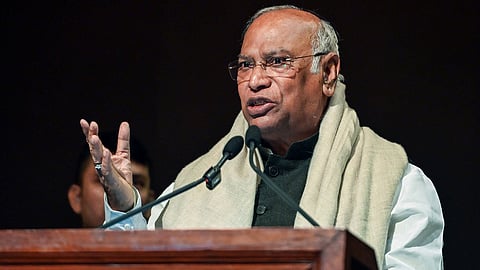

NEW DELHI: Congress president Mallikarjun Kharge on Friday launched a sharp attack on the Modi government, accusing it of "dismantling" forests and "weakening" India's environmental governance framework.
In a post on X, Kharge alleged that India's natural forests are being steadily eroded while the Modi government relies on manipulated definitions and selective accounting to "manufacture an illusion" of environmental progress.
"On World Environment Day, it is time to stop the further degradation of our forests, rivers, oceans, air, and habitats.
While PM Modi publicly urges citizens to cope with rising heat through symbolic gestures such as 'staying hydrated' to overcome the sweltering temperatures, his Govt is simultaneously presiding over one of the most aggressive and large-scale assaults on India's ecological wealth in recent history," he charged on X.
Kharge claimed that official figures and project clearances indicate that nearly 1,91,922 hectares of forest have been cleared over the past 11 years. Since 2014, he alleged, more than 1.6 crore trees have been destroyed, exposing what he described as a contradiction between the Modi government's environmental claims and the situation on the ground.
"Across the country, this ecological destruction continues unabated: In Andaman & Nicobar, the Great Nicobar project threatens to destroy ~10 lakh trees, endangering a fragile island ecosystem.
"In Madhya Pradesh, mining and infrastructure expansion are wiping out ~7 lakh trees across forest regions. In Chhattisgarh, the Hasdeo Arand coal mining project is set to fell ~5 lakh trees, severely impacting a critical biodiversity hotspot," the Congress chief said.
"In Rajasthan, he claimed, multiple development projects threaten nearly ~1.5-4 lakh trees, further weakening the already fragile Aravalli ecosystem. In Uttar Pradesh, highways and expressways have led to the removal of around one lakh trees," he claimed, adding that in Assam, highway expansion has cut nearly one lakh trees in just four years.
Kharge further alleged that in Odisha, the Bharatmala project has resulted in the felling of around 50,000 trees, while in Maharashtra, coastal road construction and mining activities are destroying around 45,000 trees along with vital mangrove ecosystems.
While the Modi government continues to claim an increase in forest cover, Kharge said the India State of Forest Report (ISFR) defines "forest cover" using satellite-based canopy density and includes not only natural forests but also rubber plantations, oil palm plantations, orchards, bamboo plantations and other tree-covered lands above one hectare.
"This deliberate conflation of plantations with natural forests masks the ongoing destruction of biodiversity-rich ecosystems and allows ecological loss to be disguised as statistical stability or even growth.
"India's natural forests are being steadily eroded while the Modi Government relies on manipulated definitions and selective accounting to manufacture an illusion of environmental progress. Studies show dense and biodiverse forests are being replaced by plantations and fragmented patches," Kharge said.
The Congress president also accused the government of weakening environmental safeguards established over decades.
"This government has weakened and dismantled India's environmental governance framework built over decades," he alleged.
Kharge said the framework was first institutionalised under former prime minister Indira Gandhi through landmark laws, including the Wildlife Protection Act, the Water Act, the Forest Conservation Act and the Air Act.
He said the framework was further expanded during the Congress-led UPA government through the Forest Rights Act, the EIA Notification, the National Green Tribunal and the National Action Plan on Climate Change.
"In sharp contrast, the Modi Government has weakened, diluted, and bypassed these safeguards through procedural relaxations, accelerated clearances, and regulatory weakening that prioritises projects over ecological protection."
Ultimately, India's environmental vision must rest on three fundamental principles: unwavering respect for the rule of law, meaningful partnership with local communities rather than conflict with them, and a recognition that environmental protection and human development are deeply interconnected.
Only through such an approach can India build a safer, healthier, and more resilient future for the 21st century," the Congress leader said.
