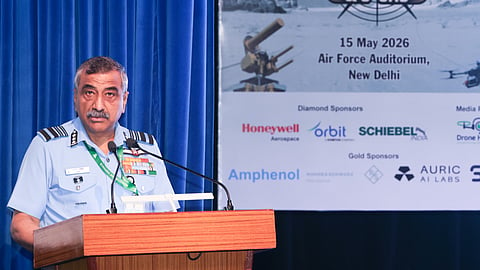

NEW DELHI: India must set up a dedicated joint drone warfare centre with tactics updated every six months and accelerate the Ghatak stealth unmanned combat vehicle (UCAV) programme with far greater urgency, Chief of Integrated Defence Staff (CISC) Air Marshal Ashutosh Dixit said Friday, warning that adversaries were already building drones specifically designed to defeat existing Indian defences.
“We cannot update doctrine every six years,” Air Marshal Dixit said at a seminar on unmanned systems organised by the Centre for Aerospace Power and Strategic Studies in the capital. “The hardware is only as good as the doctrine built around it.”
The ‘Defence Forces Vision 2047’ roadmap released earlier this year has also proposed the creation of a dedicated tri-service Drone Force as the military prepares for large-scale integration of autonomous systems across air, land and maritime domains.
The CISC said the proposed joint centre must include live simulation facilities and red team exercises, with operational concepts revised through a rolling six month tactical review cycle instead of the military’s traditionally slower doctrinal update process.
The remarks come amid a broader reassessment within the armed forces following lessons drawn from Operation Sindoor and other contemporary conflicts that have underscored the growing centrality of drones, sensor fusion and autonomous systems in modern warfare.
On Ghatak, India’s stealth unmanned combat air vehicle under development by DRDO, Air Marshal Dixit said the autonomous wingman concept must now move from experimentation to operational urgency.
“This is how the Indian Air Force (IAF) will fight,” he said, drawing a direct parallel with the US Air Force’s XQ 58A Valkyrie operating alongside F-22 fighters and Australia’s Boeing MQ 28 Ghost Bat.
The concept involves a fighter pilot controlling multiple autonomous platforms armed with sensors, electronic warfare payloads and precision weapons through networked systems and helmet-mounted controls. Such teaming would allow high-risk missions to be carried out without exposing additional pilots to danger.
The Defence Acquisition Council (DAC) earlier this year cleared the procurement of around 60 Ghatak RPSA, though the programme’s full scale prototype remains under development and operational induction is still several years away.
Air Marshal Dixit also spoke at length about the integrated air defence architecture activated during Operation Sindoor where Pakistan had deployed a deliberate combination of Turkish Songar systems and Chinese platforms, using surveillance drones, loitering munitions and strike assets in an attempt to probe, confuse and overwhelm Indian air defences.
Subsequent Pakistani attempts to saturate Indian airspace with hundreds of drones were countered through an integrated air defence network that linked the Army’s Akashteer system, the Navy’s Trigun architecture and the IAF’s Integrated Air Command and Control System into a common operational grid, he said, adding, “It worked. Now we must build on it.”
The CISC further said that the architecture must now evolve into a permanent tri-service counter drone and air defence network under Project Sudarshan Chakra. The ten-year initiative, announced by Prime Minister Modi during his Independence Day address last year, aims to build an indigenous multi-layered air and missile defence shield by 2035.
Crucially, Air Marshal Dixit warned that adversaries were already moving beyond conventional radio frequency-linked drones. “Adversaries are building drones that can defeat RF jamming using fibre-optic control links, AI-enabled autonomous navigation and low-observable airframes,” he said.
He argued that India’s counter-drone architecture would now have to increasingly rely on “passive electro-optical and infrared sensors, acoustic detection systems and AI-enabled threat classification”, alongside conventional electronic warfare capabilities.
The top officer also highlighted the growing use of optical fibre-based tethered drones, saying such systems are effectively immune to conventional jamming and spoofing and offer a major advantage in contested electromagnetic environments.
Looking beyond the air domain, Air Marshal Dixit said unmanned systems were “only the opening act of coming robotic warfare.” Autonomous systems would increasingly dominate ground combat, underwater warfare and military space operations, forcing all three services to fundamentally rethink force structures and operational doctrines, he said.
Russia was already testing robotic combat systems in Ukraine, China’s PLA had deployed autonomous underwater gliders in the South China Sea, and DARPA was integrating robotic systems into infantry formations, he said. “These are not experiments. They are deployments, and they are accelerating,” the CISC said, adding that India’s armed forces would also have to rapidly scale up the integration of unmanned and autonomous systems across services.
