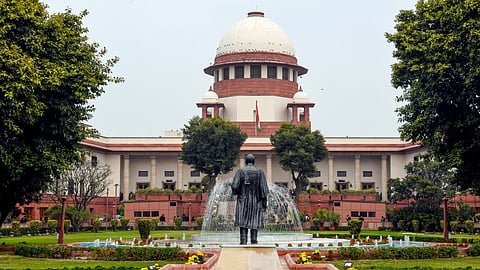

NEW DELHI: The Supreme Court on Wednesday sought detailed responses of the Centre, CBSE and the NCERT after hearing the plea challenging the mandate on three languages, including two regional languages for students from Classes VI to IX.
While agreeing to examine a plea challenging a CBSE policy mandating the study of three languages, including at least two native Indian languages, for Class IX students beginning July 1, a bench of Chief Justice Surya Kant and Justices Joymalya Bagchi and Vipul M Pancholi issued notices to the Centre, CBSE and the NCERT and sought their replies within two weeks.
According to a recent circular issued by the Central Board of Secondary Education (CBSE), the study of three languages, including at least two native Indian languages, has been made compulsory for Class 9 students beginning July 1. “We need a detailed reply from the respondents, as the logistical concerns arising from the implementation of the policy would require closer examination,” the bench noted.
“Let us have a comprehensive reply. We can hear on June 15. There will be logistical issues,” observed CJI Kant.
The writ petition under Article 32 has been filed by a group of 19 petitioners comprising parents and teachers from Delhi, Gurugram, Noida and Chennai against the Union of India, the CBSE, and the NCERT. The petition challenges CBSE Circular of May 15, 2026.
According to the petition, the impugned circular mandates that with effect from July 1, 2026, Class IX students must study three languages (R1, R2 and R3), with at least two being native Indian languages.
Also in top court
Collegium proposes names for SC judges
The Supreme Court Collegium has recommended the elevation Justices Sheel Nagu (Punjab & Haryana HC), Shree Chandrashekhar (Bombay HC), Sanjeev Sachdeva (Madhya Pradesh HC) and Arun Palli (J&K HC) and senior advocate V Mohana to the top court.
