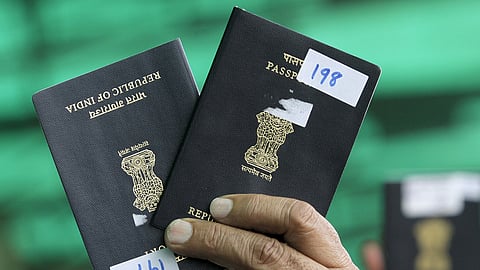

NEW DELHI: The Centre has overhauled India’s visa regime, reducing the number of main visa categories from 13 to nine and sub-categories from 49 to 23, in a bid to simplify entry procedures and attract more foreign tourists, medical travellers, students, investors and business professionals.
The Union Ministry of Home Affairs (MHA), which announced the changes in 2026, has also reduced the number of fields in visa application forms by 65-70 per cent across all 23 sub-categories, significantly cutting down the information applicants need to furnish.
The revised framework seeks to eliminate overlapping provisions, make visa selection more straightforward and facilitate legitimate foreign travel to India for tourism, healthcare, education, research and business.
Noting that the latest exercise follows an earlier rationalisation in October 2025, when the government reduced the number of main visa categories from 22 to 13 and sub-categories from 63 to 49, officials in the MHA said the changes were undertaken after studying visa systems in developed countries and global practices.
“One of the key changes is the renaming of the erstwhile Tourist Visa as the Visitor Visa, reflecting a wider range of activities permitted under the category. The new Visitor Visa has been divided into two sub-categories, V-1 and V-2,” he said.
According to the officials, the V-1 visa, valid for 30 days with multiple entries, will cover short-term visits, including business meetings, medical consultations, wellness retreats, short-duration medical treatment and courses in Indian languages, music, art and craft, while the V-2 visa will cater to longer visits, with validity of one, five or 10 years, depending on eligibility. It will also cover mountaineering, for which a six-month multiple-entry visa will be issued, he added.

The Medical Visa framework has also been streamlined to facilitate medical value travel. The M-1 visa will cover treatment other than under AYUSH systems, while the M-3 visa will apply to treatment under AYUSH.
“Both, including their e-visa variants, will ordinarily be granted for one year with multiple entries. Separate attendant visas, M-2 and M-4, will be available for persons accompanying patients under the respective categories,” the official said.
The move is expected to provide greater continuity for foreign patients requiring multiple consultations, follow-up visits or extended treatment, while supporting the government’s ‘Heal in India’ initiative.
The Student Visa category has been consolidated into two broad sub-categories. S-1 will cover school, graduate and postgraduate education, while S-2 will include PhD scholars, researchers, visiting faculty, internships, exchange programmes and specified scientific and academic activities.
Foreign students admitted to Indian institutions through the Study in India portal may be granted an e-S1 visa for up to five years or the duration of their academic course, whichever is shorter, with multiple entries.
The Business Visa category has similarly been reorganised into B-1 and B-2. While B-1 will cover long-term, licence-based business activities, including setting up industrial and commercial ventures, B-2 will cater to short-term, contract-based assignments, conferences, sports, performing arts and film-related activities.
A specific provision under B-2 has also been introduced for foreign technical experts, engineers and subject-matter specialists engaged by Indian companies. It will facilitate the deployment of overseas professionals for installation, commissioning, quality checks, maintenance, production, IT and ERP operations, training, plant design and technology transfer.
Such professionals can also avail themselves of the Production Investment Business Visa through the e-visa platform, a facility earlier provided under the e-B4 nomenclature.
Currently, India’s e-visa facility is available to nationals of 172 countries across 13 sub-categories.
The MHA official said the reduction in application-form fields would make the process less time-consuming for applicants while improving administrative efficiency and enabling more focused scrutiny of applications.
The ministry is now upgrading its information technology systems to operationalise the revised framework, he said, adding that visas under the new system are expected to be issued by the end of 2026.
As per government data, nearly 25,000 foreigners are residing in India on Employment Visas, while over 40,000 were granted Student Visas on arrival. In the case of Medical and related Visas, over 18 lakh were issued during 2023-25, while nearly 5,000 AYUSH and attendant visas have been issued since the launch of the scheme in 2026.