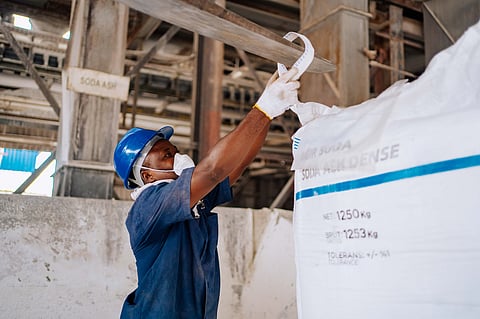

A new study reveals that despite deteriorating relations with Türkiye following last year’s conflict with Pakistan, India continues to import soda ash in large quantities, negatively impacting its domestic industry. Industry experts are calling for immediate regulations on soda ash imports to support Indian manufacturers and reinforce the country’s ambitions in clean tech manufacturing.
Soda ash (sodium carbonate, Na₂CO₃) is a fundamental industrial chemical used in photovoltaic panels, the processing of lithium carbonate for batteries in electric vehicles and energy storage, as well as in other applications such as glass production, detergents, and water treatment.
The report, titled “Soda Ash Industry in Global Value Chains: Trade Dynamics, Production Landscape, and India’s Strategic Role,” warns that increased import dependence could jeopardize India’s goals for Atmanirbharta in clean energy and advanced manufacturing.
Released by the Centre for Domestic Economy Policy Research (C-DEP) in collaboration with the Centre for WTO Studies (CWS) at the Ministry of Commerce and Industry in Delhi, the report highlights an alarming 81.3% increase in soda ash imports since FY 2021–22. As of FY 2024–25, imports accounted for 22% of India’s soda ash demand, despite the existence of sufficient domestic production capacities.
“India cannot aspire to be a global leader in solar energy and electric mobility while weakening its domestic industries that supply essential raw materials,” remarked Dr.Jaijit Bhattacharya, President of C-DEP Research (C-DEP.in).
“Despite having ample soda ash manufacturing capacity, India is becoming increasingly import-dependent. If this trend continues, we risk repeating past mistakes, such as with pharmaceutical intermediates like Penicillin G, where the loss of domestic production led to reliance on foreign suppliers. We must protect our existing industrial capabilities before they are lost.”
The report attributes the surge in imports to global overcapacity, falling international prices, and the redirection of surplus production toward India.
The United States, China, and Türkiye collectively produce nearly 80% of the world’s soda ash. Average dumping has increased by 42.8% between FY 2022–23 and FY 2024–25, intensifying pressure on domestic producers and deterring future investments.
The WTO provides provisions for countries facing sudden surges in imports, allowing them to impose quantitative restrictions to protect their domestic industries. The report recommends the prompt implementation of an initial safeguard import quota of 755,000 tonnes, which the Directorate General of Trade Remedies (DGTR) has suggested.
“The sharp increase in soda ash imports requires careful assessment. WTO-compliant safeguard measures offer a legitimate means to address import surges and their effects on domestic producers,” stated Dr. James J. Nedumpara, Head of the Centre for WTO Studies at the Ministry of Commerce.
“One of the report’s recommendations is to impose an import quota that manages these pressures while still allowing access for downstream industries. A balanced approach can support domestic manufacturing and future investments.”
Industry bodies are advocating for a level playing field to compete with imports. India aims to establish 500 GW of green energy capacity, with solar panels playing a crucial role in this endeavour. For India, the soda ash industry is not only vital economically; it also employs thousands of people throughout its value chain.
“The manufacturing of soda ash involves producing salt through multiple chemical processes and the use of limestone, which creates numerous job opportunities,” explained RS Jalan, an industry expert.
“We demand a level playing field rather than a ban on imports,” Jalan reiterated.
Ashish Desai, another industry representative, warned that if imports continue at this rate, India may have to shut down its detergent industry and rely on imports from Turkey and China.
