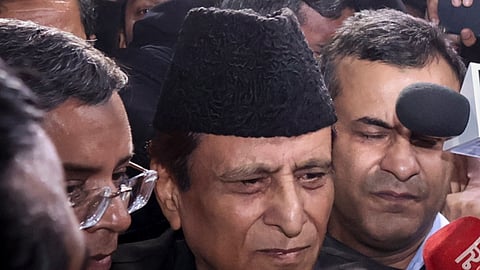

NEW DELHI: The Supreme Court on Wednesday said a stay of conviction cannot be granted merely to enable a politician to contest an upcoming election, holding that electoral ambitions cannot be the basis for exercising the exceptional power.
A bench of Justices Dipankar Datta and Sheel Nagu laid down the principle while dismissing the Uttar Pradesh government's appeal against an Allahabad High Court order in the fake birth certificate case involving senior Samajwadi Party leader Azam Khan, his wife Tazeen Fatma and son Abdullah Azam Khan.
The court upheld the stay of conviction granted to Azam Khan by the High Court and extended the relief to his wife and son, observing that all three were implicated in a single conspiracy charge.
"We unequivocally disavow and reject any plea that seeks a stay of conviction anchored purely on political expediency, electoral ambitions, or the exigencies of upcoming election campaigns. Courts of law cannot permit statutory powers to be leveraged to suit political calendars or electoral ambitions," the bench said.
The court distinguished between suspension of sentence and stay of conviction, noting that while suspension of sentence halts imprisonment, a stay of conviction temporarily suspends the legal consequences flowing from the conviction, including disqualification from contesting elections.
It said the latter required stronger justification, as it effectively suspends the finding of guilt itself.
Relying on its ruling in the Afjal Ansari versus State of Uttar Pradesh case, the bench said courts must balance the possible irreversible harm to an individual's reputation and dignity under Article 21 of the Constitution against the sanctity of a conviction until it is set aside.
The ruling arose from a May 2024 Allahabad High Court order that suspended the sentences of the three accused and granted them bail, but stayed the conviction only in the case of Azam Khan.
The Supreme Court found the distinction arbitrary, noting that the case stemmed from a single conspiracy charge under Section 120B of the Indian Penal Code involving two birth certificates issued in Rampur and Lucknow. No separate act of forgery was attributed to Fatma or Abdullah, the bench noted.
The case originated from a complaint filed by BJP leader Akash Saxena in January 2019, alleging that two birth certificates had been obtained for Abdullah. A Rampur court convicted the three in October 2023 for cheating, forgery and criminal conspiracy and sentenced them to seven years in prison.
The Supreme Court directed that the stay of conviction would continue until the Allahabad High Court decides their revision petitions.
Separately, Azam Khan was released from Dasna district jail in Ghaziabad on Wednesday evening after the Allahabad High Court granted him interim bail on Tuesday in a money laundering case linked to his Mohammad Ali Jauhar University.
Khan's advocates moved an application before the special Prevention of Money Laundering Act (PMLA) court in Ghaziabad on Wednesday, seeking his release in compliance with the High Court's order. The court issued the release order in the afternoon, advocate Mohammad Yasir Abbasi said.
Abbasi said the court directed Khan's release on furnishing two bonds of Rs 50,000 each. The High Court has scheduled the next hearing in the matter for December 10.
Khan's sons, Mohammad Abdullah Azam Khan and Mohammad Adeeb Azam Khan, arrived at Dasna jail from Rampur to receive him. The Samajwadi Party leader did not respond to questions from mediapersons after his release.
Khan had been lodged in Dasna jail since November 1, a day after the Enforcement Directorate (ED) arrested him in the money laundering case, shortly after he walked out of Rampur jail on bail in another criminal case.
The ED's action followed an investigation into alleged financial irregularities involving the Maulana Mohammad Ali Jauhar Trust, founded and controlled by Khan, and the construction of the university.
Meanwhile, the Supreme Court on Wednesday declined to stay the interim bail granted to Khan in the money laundering case, with a bench headed by Chief Justice of India Surya Kant observing, "Heavens are not going to fall. Let him be on interim bail."
The bench, also comprising Justices Joymalya Bagchi and V Mohana, agreed to hear the ED's challenge to the November 17 Allahabad High Court order on Thursday.
Additional Solicitor General S V Raju, appearing for the ED, argued that the High Court had granted interim bail despite the agency's claim that it had attempted to serve the written grounds of arrest on Khan, who allegedly refused to accept them.
The High Court had granted interim bail after finding that the ED had not furnished the written grounds of arrest to Khan before producing him for remand. It had directed the agency to file a detailed counter-affidavit and allowed Khan time to submit his rejoinder.
(With inputs from PTI)
