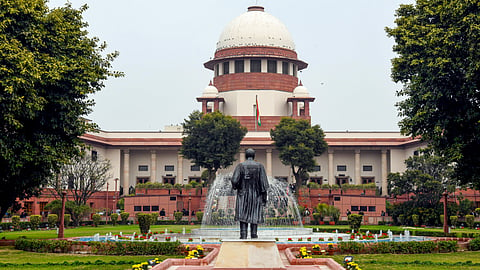

The Supreme Court on Thursday ruled that final adjudication of property attachment proceedings by the Adjudicating Authority under the Prevention of Money Laundering Act (PMLA) must include a judicial member to ensure fairness and objectivity in decisions with serious consequences.
A Bench comprising Chief Justice of India Surya Kant and Justices Joymalya Bagchi and V Mohana also recommended that the Centre consider "repealing the 2009 amendment and reverting to the original framework of multiple adjudicating authorities (AAs)", citing the exponential increase in provisional attachment orders passed by the authorities.
The Bench noted that 3,639 provisional attachment orders had been passed by AAs between March 31, 2012, and Thursday.
It observed that the increasing volume of cases and the statutory requirement to complete adjudication within 180 days were placing enormous pressure on members of the Adjudicating Authority.
"We are satisfied that the member drawn from the field of law must comprise or be a part of the Bench of AA recording a determination under Section 8(2) or issuing an order under Section 8(3) of PMLA," the CJI, who authored the 55-page judgment, said.
The verdict, which will apply prospectively, said determinations under Sections 8(2) and 8(3) of the PMLA concerning the attachment of properties allegedly involved in money laundering require close analysis of legal provisions, appreciation of facts and consideration of substantial civil consequences.
"The presence of a judicial member on the bench undertaking the same ensures legal objectivity in the determination recorded by AA. The lifetime of experience of the administrative and financial members in the AA would undoubtedly render them to be exceptional experts in their fields, but impartial and legally sound adjudication necessitates judicial temperament and training," the verdict said.
Referring to earlier judgments, the Bench said they had espoused the principle that a person is entitled to have their rights adjudicated by a forum exercising judicial power in accordance with recognised principles of adjudication.
"There is no doubt that these postulates would directly apply to the AA's adjudicatory responsibilities," it said, rejecting the Centre's submissions that similar bodies under the NDPS, SAFEMA, Benami Act and Customs Act did not require a judicial member.
Terming the Centre's argument "misplaced", the verdict said that although other penal laws provided for mechanisms to attach, confiscate and forfeit property, they were "not pari materia with the AA".
"These purportedly comparable legislations do not provide that at least one of the members of the subject authority must be a judicial member, i.e., a person having experience in the field of law. Section 6(2) and (3) are, on the other hand, expressed in their mandate for one of the three members of the AA to have legal background, indicating a conscious decision of the Legislature to ensure the availability of a judicial member in the AA," it said.
The Bench, however, clarified that a single-member Bench of the Adjudicating Authority, even if it comprises a non-judicial member, can issue show-cause notices under Section 8(1) of the PMLA.
However, subsequent hearings and final determinations under Sections 8(2) and 8(3), which establish whether a property is involved in money laundering and whether its attachment should be confirmed, must be conducted by a Bench comprising or including the judicial member.
The ruling was delivered in a batch of appeals arising from judgments of the Delhi, Calcutta and Telangana High Courts, which had upheld proceedings conducted by single-member Benches of the PMLA Adjudicating Authority without the participation of a judicial member.
The court further noted that confirmation of an attachment could result in the government taking possession of the property, potentially depriving the affected person of its benefits for a considerable period, even before the conclusion of the criminal trial.
Emphasising the importance of judicial independence, the court said the availability of an appellate remedy before the appellate tribunal or the High Court could not substitute for the requirement of an independent judicial mind at the original adjudication stage.
The verdict also clarified that the judicial member need not necessarily be appointed chairperson of the Adjudicating Authority.
Accordingly, the court held that the chairperson could belong to any of the fields recognised under the statutory framework, provided the judicial member participated in the Bench undertaking final adjudication under Sections 8(2) and 8(3) of the PMLA.
The court modified the judgments of the Delhi, Calcutta and Telangana High Courts and directed that pending complaints and applications before the Adjudicating Authority be decided in accordance with the principles laid down in the judgment.
Interim protection granted in the connected matters was also vacated.
(With inputs from PTI)
