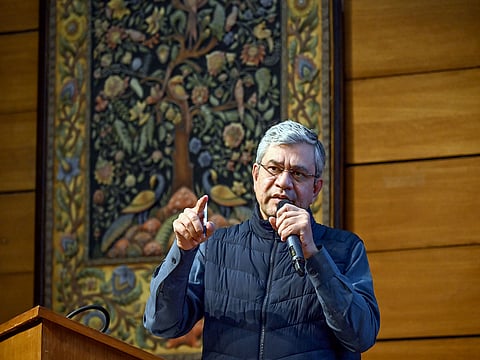

The Centre will release a consultation paper on regulating artificial intelligence within a month, with AI safety, deepfakes, user harm and a human-first approach among its key focus areas, IT Minister Ashwini Vaishnaw said on Thursday.
Speaking at the India launch of the World Development Report 2026, The Promise of Artificial Intelligence, Vaishnaw said the time had come for India to have an AI regulatory framework, with the proposed paper expected to form the basis for future regulations.
“I’ll request the department to come out with a regulation-focused consultation paper, which focuses on safety. That’s the most important point... safety-related to AI use,” he said.
Vaishnaw said deepfakes would be a major area of focus, describing them as a “nuisance which can cause huge problems in society”. He said the quality of deepfakes was improving rapidly, making it increasingly difficult for people to distinguish them from genuine content.
“People believe them, and it sets a totally wrong precedent. It sets a totally wrong narrative, and people get lured into doing wrong things and believing wrong things,” he said.
The consultation paper will also address AI-related harms, cybersecurity, psychological disorders, skilling and ensuring that no section of society is left behind, Vaishnaw said.
“Humanity has to be the most important part of change that has happened,” he said, stressing that AI regulation could not be achieved through laws alone.
“Government has always maintained that AI and other technologies cannot be regulated by law alone. We have to bring a techno-legal solution,” the minister said.
He also emphasised that the technology industry would have to shoulder the primary responsibility for addressing risks arising from AI.
“The industry has to take the primary responsibility,” Vaishnaw said, listing cybersecurity, safety, user harm, psychological disorders and deepfakes among the key concerns.
India has already tightened its rules for AI-generated and synthetic content. In February, the government amended the IT rules to impose stricter obligations on online platforms, including requiring them to remove AI-generated content flagged by a competent authority or court within three hours.
On the government’s use of AI, Vaishnaw said an empanelment model would be followed instead of directly awarding tenders for AI solutions. Selected firms and startups would be eligible to participate in tenders floated by government departments seeking to deploy AI technologies.
The government is also working on long-term procurement of computing capacity, he said, adding that an RFP had been issued for a five-year supply agreement.
“Our demand estimate is for 10,000 GPUs, and the first tender that we are coming out is for 5,000 (GPUs),” Vaishnaw said.
He added that the government was working to develop indigenous GPUs under its semiconductor programme, initially targeting chips for AI inference. “That roadmap looks visible now,” he said.
(With inputs from PTI)
