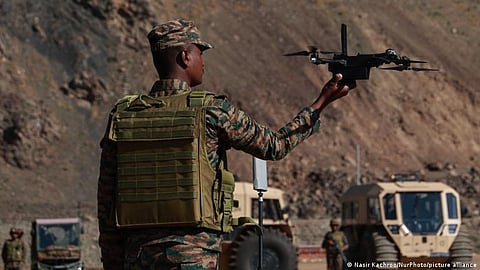

NEW DELHI: The Army has inducted 450 indigenous Nagastra-1R loitering munitions, its largest single batch of such 'kamikaze' drones till now, as it scrambles to build a bigger precision-strike arsenal after Operation Sindoor.
Loitering munitions hover over a target area before diving into it with their warheads. The Nagastra family has already been battle-tested. Defence minister Rajnath Singh said earlier this year that Nagastra drones had hit terrorist targets with precision during Operation Sindoor.
The drones are made by Nagpur-based Solar Defence and Aerospace Ltd (SDAL), earlier known as Economic Explosives Ltd. The Rs 158-crore order was placed in June last year under the emergency procurement (EP) powers given to the armed forces after the hostilities with Pakistan last year.
SDAL in a statement on Tuesday said that it was the only one of four firms in the trials to meet all operational parameters. The contract required it to be delivered within a year. It took a little over a year.
The order is a follow-on to an earlier EP contract for 480 Nagastra-1 drones, inducted in 2024. The first 120 were delivered to the Pulgaon ammunition depot in June that year and the full lot came in by December.
The Nagastra-1 carries a 1-kg warhead, can strike targets up to 30 km away and stays airborne for an hour. If it fails to find a target or the mission is aborted, it can be recalled and recovered by parachute for reuse.
The IR variant has a 360-degree gimbal camera, an optional thermal camera for night operations, encrypted video and telemetry links, and a reusable launcher. The company claims a strike accuracy of 2 metres and over 80% indigenous content.
The induction comes as the armed forces race to plug critical capability gaps. A defence ministry document has itself acknowledged that domestic industry could not supply niche drones, counter-drone systems and loitering munitions during Op Sindoor.
The armed forces have since inked EP contracts worth around Rs 30,000 crore, largely for drones, counter-drone systems, radars and electronic warfare equipment.
SDAL, meanwhile, is developing the Nagastra-2 and Nagastra-3, with heavier warheads.
