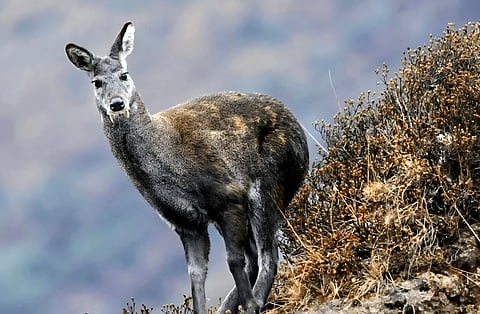

DEHRADUN: Uttarakhand’s state animal, the alpine musk deer, faces mounting conservation concerns, with India’s recognised zoos reporting just two living captive Himalayan musk deer—both male—and no females, information obtained under the Right to Information Act shows.
The Central Zoo Authority’s (CZA) inventory, based on figures submitted by recognised zoos as of September 2026, lists one male at Jammu Zoo and another at Himachal Pradesh’s Himalayan Nature Park.
The absence of females raises questions about the scope for captive breeding. The RTI disclosures also record two musk deer deaths in zoos over the past five years, both in Himachal Pradesh. The CZA’s reply on Monday did not specify the causes.
The Authority said no funds for musk deer breeding programmes were released or spent during the period covered by the RTI request.
In a separate reply dated October 8, it said it had not specifically allocated or released funds to Uttarakhand for musk deer conservation or captive breeding between 2021–22 and 2026–27. “Musk itself has become the animal’s enemy. Poachers kill musk deer to extract it; unfortunately, the animal has to be killed to obtain it,” Noida-based environmental and wildlife expert Amit Gupta told TNIE.
Another concern is the Chopta Musk Deer Breeding Centre in Uttarakhand, which is not recognised by the CZA as a zoo. The RTI applicant had sought details of directives, advisories or show-cause notices issued to the state Forest Department after breeding errors or failures were highlighted in a 2024 strategic report.
The CZA said it had issued no such notices or directives because the Chopta facility falls outside its recognised-zoo framework. The response leaves questions about the centre’s regulatory oversight, animal identification, breeding records and which authority is responsible for monitoring its conservation work.
Wildlife enthusiast and analyst Dr Kanchan Negi said musk deer resemble ordinary deer, but are not classified as true deer biologically. “They are often regarded as deer in popular belief. Their sense of smell is said to be sharper than that of dogs,” she told TNIE.
Negi said the animals are found in the Himalayas at elevations of 3,600 to 4,400 metres, particularly in Kedarnath, the Valley of Flowers and Pithoragarh. The species has an average lifespan of about 20 years.
Uttarakhand declared it the state animal in 2001, she said. The RTI information indicates that Uttarakhand has not conducted a musk deer census since 2010, when 376 animals were recorded. No updated state population estimate was provided.
Negi cited a figure of 279 animals in the state in 2005, underscoring the need for consistent surveys to track population changes. The material supplied in response to the request does not give the total number of musk deer poaching cases recorded in Uttarakhand between 2020 and 2025.
Without current population data and clearer information on illegal hunting, the scale of the threats remains difficult to establish. The disclosures point to gaps in monitoring and captive-breeding support.
Conservation experts say updated surveys, stronger oversight and a clear habitat-protection plan are needed to safeguard the species. Despite its status as the state animal, the musk deer’s future remains uncertain.
