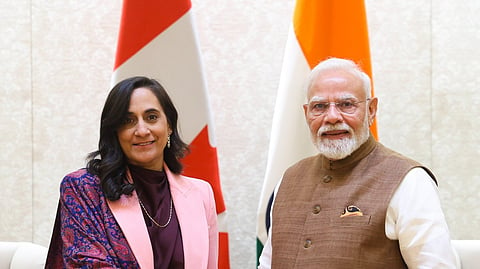

NEW DELHI: India is stepping up efforts to strengthen its strategic and economic partnerships with Canada, with Prime Minister Narendra Modi meeting Canadian Foreign Minister Anita Anand on Wednesday to advance bilateral cooperation, while External Affairs Minister S Jaishankar signalled that India-US trade negotiations were approaching a ‘landing point.’
Modi and Anand discussed ways to strengthen India-Canada relations across trade, technology, defence, security, energy, education and people-to-people exchanges, an official release said.
Modi described the meeting as productive and reiterated India’s commitment to developing a forward-looking partnership with Canada.
“India is committed to building a constructive and forward-looking strategic partnership with Canada that delivers tangible benefits to the people of both countries,” he said.
The PMO said the two sides emphasised the need to sustain momentum in bilateral engagement and translate recent diplomatic progress into concrete outcomes.
An early conclusion of negotiations on a Comprehensive Economic Partnership Agreement (CEPA) was identified as an important priority. The leaders also exchanged views on regional and global developments. Modi conveyed his greetings to Canadian Prime Minister Mark Carney and expressed his intention to continue engaging with him.
The meeting followed a telephone conversation between Modi and Carney on Tuesday, signalling continued high-level engagement between the two countries as they work to rebuild and broaden bilateral ties.
In a statement, the Canadian High Commission said Anand and External Affairs Minister S Jaishankar had discussed the positive momentum in the renewed Canada-India Strategic Partnership, supported by sustained high-level engagement over the past year.
Anand spoke about the importance Canada attaches to India as a partner, particularly amid growing geopolitical uncertainty.
Meanwhile, Jaishankar said India and the United States were continuing to work through outstanding differences in negotiations for a bilateral trade agreement, suggesting that the process was moving towards a possible resolution. “My sense is that this is an issue which is heading towards a landing point,” Jaishankar said at the Bloomberg New Economy Forum on Tuesday evening.
Jaishankar said negotiations with Washington involved not only the terms agreed between the two countries but also how each country’s exporters would fare against international competitors.
Jaishankar linked the trade negotiations to a broader shift in US economic policy, arguing that Washington’s increased reliance on tariffs reflected its determination to rebuild domestic manufacturing and redefine access to its market.
“The US has a fundamentally different approach to the use of tariffs,” he said, describing the tariff debate as closely connected to American reindustrialisation. Jaishankar also addressed India’s relationship with China and said that lasting improvements in bilateral ties would require peace and stability along the disputed border.
“The point we make to the Chinese is, ‘If you want a normal relationship, if the rest of the relationship is to move, it's common sense -- it is a no-brainer that the boundary has to be stable and that we need peace and tranquillity in the border areas,” he said.
Jaishankar said the situation along the Line of Actual Control (LAC) has “settled down” to a considerable extent since 2024, with bilateral relations correspondingly moving towards normalcy.
The two countries have introduced confidence-building measures following the end of the prolonged military standoff in eastern Ladakh in late 2024. However, New Delhi continues to regard border stability as essential to broader progress in political and economic relations.
