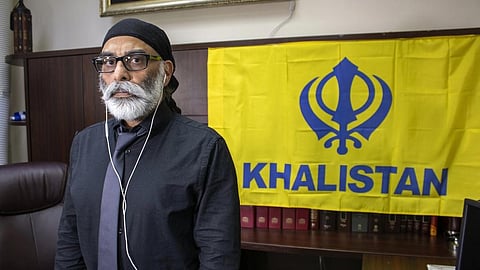

CHANDIGARH: The banned pro-Khalistan organisation Sikhs for Justice (SFJ) has announced a “Khalistan referendum” event in Edmonton, Alberta, on October 18, at a time when India and Canada are seeking to strengthen bilateral ties across trade, energy, technology and security.
The event comes amid debate over Alberta’s political future, with a province-wide referendum expected in 2026 on whether the province should remain part of Canada or begin a legal process that could eventually lead to separation.
SFJ has also sought to draw parallels with a referendum planned for October 19 by Quebec’s Parti Québécois. SFJ chief Gurpatwant Singh Pannun has reportedly invited the party’s leaders to attend the Edmonton event. Pannun has organised similar referendum-style events in the past.
SFJ says it is conducting non-binding referendums among Sikh communities in different countries as part of its campaign. The Edmonton event could raise concerns as Prime Minister Narendra Modi and his Canadian counterpart, Mark Carney, have agreed to deepen their strategic partnership in trade, energy, technology, security and people-to-people ties.
Canada is leading its largest trade delegation to India in more than 30 years, with nearly 300 business delegates visiting Mumbai and Bengaluru from October 12 to 17 to explore partnerships across key sectors. Both countries are seeking to strengthen economic ties and advance negotiations on a Comprehensive Economic Partnership Agreement (CEPA).
Canadian International Trade Minister Maninder Sidhu said the Team Canada Trade Mission would focus on aerospace, clean energy, technology, life sciences, agri-food and forestry, connecting Canadian businesses with opportunities in India’s expanding market.
In a post on X, Sidhu said the mission aimed to build new partnerships and create opportunities for Canadian workers and businesses. He also highlighted ongoing CEPA negotiations, which both countries are targeting to conclude by the end of 2026.
Meanwhile, Canadian Foreign Minister Anita Anand is visiting India from October 13 to 16 as part of a two-nation tour that also includes the United Arab Emirates.
Canada aims to increase bilateral trade with India to USD 70 billion by 2030, from about USD 30 billion currently. According to the Canadian government, bilateral trade reached USD 30.4 billion in 2025, including USD 11 billion in goods. The trade mission comes as the two countries seek to expand cooperation in manufacturing, technology, energy and agriculture.
The fifth round of CEPA negotiations began in Ottawa earlier this month, with energy, critical minerals and aerospace emerging as key areas of collaboration. The talks follow discussions between Sidhu and Union Commerce and Industry Minister Piyush Goyal on the sidelines of the G20 Trade Ministers’ Meeting.
India condemns anti-India activities
A few days ago, Ministry of External Affairs spokesperson Randhir Jaiswal was asked about the proposed event and its timing ahead of an October 19 vote concerning Alberta’s future within Canada. Jaiswal did not name any country or organisation in his response.
“We had a question about certain developments happening in certain parts of the world. On that, I can say that we strongly condemn all anti-India activities,” he said.
Security concerns surrounding the Khalistan campaign have also become more visible in Alberta. In August, the Royal Canadian Mounted Police (RCMP) issued a “duty to warn” notice to Manjinder Singh, an Abbotsford-based Sikh activist involved in the Khalistan campaign, warning him that his life faced a credible, serious and imminent threat. Police did not disclose the nature of the threat or identify those believed to be behind it.
Another activist, Inderjeet Singh Gosal of Ontario, also received an RCMP warning. Gosal has served as a Canadian coordinator of the Khalistan referendum campaign.
India has repeatedly expressed concern over the activities of pro-Khalistan groups operating from Canadian territory and urged Ottawa to prevent anti-India activities by individuals and organisations based in the country. In November 2022, New Delhi reiterated its objections to plans to hold a referendum in Canada on the demand for Khalistan and called on the Canadian government to prevent such activities.
Relations between the two countries remained strained following the killing of Sikh separatist Hardeep Singh Nijjar in June 2023. Tensions deepened after then Canadian Prime Minister Justin Trudeau accused India of plotting the murder.
SFJ ban extended in 2024
In 2024, the Union government extended the ban on SFJ by another five years under the Unlawful Activities (Prevention) Act. A government notification stated that the organisation had been engaged in activities prejudicial to India’s integrity and security.
The National Investigation Agency (NIA) has registered several cases against the organisation and Pannun. The Centre first banned SFJ in 2019.
