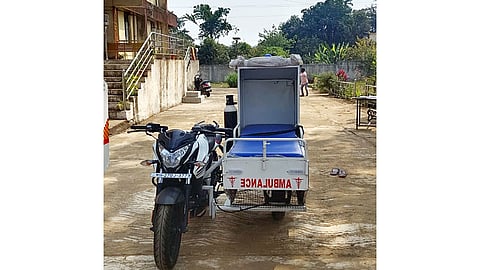

NEW DELHI: The Centre has notified a set of safety and fitness requirements for two-wheeled road ambulances, including mandatory checks of stretchers, restraint systems, emergency warning lights and fire extinguishers. The notification was issued on October 13 after considering objections and suggestions received from the public with regard to amendments to the Central Motor Vehicles Rules, 1989, to regulate ambulance services.
Under the new rules, the fitness certificate of a two-wheeled road ambulance will be renewed every two years. The state governments will decide in which areas two-wheeled road ambulances can be registered and ply. The new rules will come into force on the date of their final publication in the Official Gazette.
In July, the Ministry of Road Transport and Highways (MoRTH) issued a notification proposing a regulatory framework to facilitate rapid emergency response services in rough terrain and remote areas that are difficult to access using conventional medical transport vehicles, and sought public views.
The ministry, through the Central Motor Vehicles (Thirteenth Amendment) Rules, 2026, has amended the Central Motor Vehicles Rules, 1989, to bring two-wheeled road ambulances under a specific regulatory framework.
In the notified rules, a detailed inspection checklist has also been introduced to assess the safety of the ambulance and its patient-carrying equipment.
The checklist requires inspectors to verify that the ambulance accessory or patient conveyance unit is securely mounted on the base vehicle, with mounting brackets, fasteners and structural members free of loose bolts, cracks, deformation or other damage that could affect safety.
The rules further mandate checks on emergency warning or flashing lights, the presence and secure mounting of the patient stretcher, its locking mechanism and the patient restraint system. As per the rules, the loading and unloading mechanism of the stretcher must also operate smoothly without jamming, excessive force or instability.
Two-wheeled road ambulances can support rapid emergency response and last-mile access to medical care in rural and remote locations, as well as hilly terrain.
The move assumes significance as there were no national requirements governing their construction, functional safety, patient-handling systems, type approval, registration and fitness inspection so far.
Two-wheeled road ambulances in the L2 (standard two-wheelers) category manufactured on or after October 1, 2027, will have to comply with AIS-209 (Part 1):2026. Emergency top lights fitted on two-wheeled road ambulances are proposed to comply with AIS-209 (Part 1):2026 from October 1, 2027.
