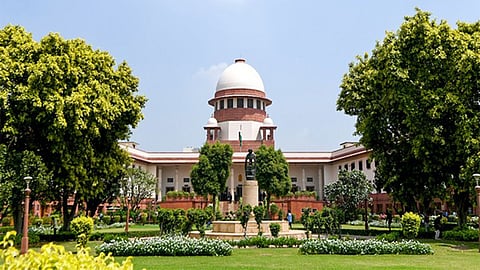

NEW DELHI: The Election Commission of India (ECI) on Monday told the Supreme Court that all decisions relating to the Special Intensive Revision (SIR) of electoral rolls were taken unanimously, defending its actions and opposing a plea seeking to restrain Chief Election Commissioner (CEC) Gyanesh Kumar from functioning.
In a counter-affidavit filed in response to a writ petition by Rakesh Kumar Singh alias Rakesh Singh, the poll body said the batch of petitions challenging the CEC's functioning was based entirely on a single newspaper report. "A newspaper report is not treated as evidence in the eyes of law," the ECI said in its affidavit.
The Supreme Court is expected to hear the batch of petitions on Tuesday.
ECI also said Form 6, used for voter registration, had not been amended during the SIR exercise. "Form 6 has not been amended. Only the Centre can amend it. The SIR declaration is a separate document," it said.
The affidavit, filed by the Deputy Election Commissioner, stated that it had been approved unanimously by Kumar and the two other Election Commissioners. ECI said all three SIR orders, issued in June 2025, October 2025 and May 2026, were unanimous decisions of the full Commission.
"The notes, queries or suggestions recorded by the CEC or Election Commissioners while a file is under process do not constitute decisions of the Commission. Newspaper report not treated as evidence in eyes of law," the EC said in its affidavit.
The poll body said files normally moved from one Election Commissioner to the other before reaching the CEC. In urgent cases, electronic approvals were obtained and subsequently recorded in the physical file.
The affidavit also cautioned that any officer issuing orders beyond the powers delegated to them would face action.
Addressing a controversy over a work-allocation order issued on July 28, the poll body said it had been issued by an Additional Secretary on deputation. Both Election Commissioners wrote to the Cabinet Secretary the following day. The order was never implemented following a joint direction from the two Commissioners on July 30, the EC said.
On Form 6, the Commission maintained that only the Centre could amend statutory forms and that the declaration required under the SIR was a separate document.
"While admitting online display could be read as amendment, Commission said from October 21 online application would be split into Form 6 and separate declaration, mirroring physical form," the EC said.
The affidavit also clarified the procedure for unmapped voters, stating that they did not need to attend hearings. Booth Level Officers would collect documents from their homes, with hearings restricted to exceptional cases and preferably conducted online to avoid harassment.
On the ECINet system, the poll body said no name could be added to or deleted from electoral rolls except through an order issued by an Electoral Registration Officer. It added that a committee comprising experts from the Indian Institutes of Technology (IIT) and the Indian Institute of Science (IISc) had been constituted to examine compliance.
ECI said that it also addressed specific cases raised in public discourse. In Goa, of the 97 voters described as "left out", 88 had already been enrolled, six were abroad and three held Portuguese passports.
In West Bengal, appeals against the inclusion of voters had been filed by officers of the Chief Electoral Officer under earlier Supreme Court orders. These matters had not been brought to the Commission's notice, it said.
The ECI argued that any plea seeking to restrain the CEC from functioning was not maintainable, as the CEC could be removed only through the same process applicable to a Supreme Court judge.
"The plea for passing of an order restraining the CEC would not be maintainable. Three members are appointed to the Commission so that, in case of a difference of opinion, a majority can be arrived at and decisions taken under Section 18 of the 2023 Act. Any prayer for restraint against the functioning of the CEC is not maintainable and even otherwise, having regard to the principle of unanimity/majority envisaged under Section 18 of the 2023 Act, would deserve to be rejected by the orders of this court," it said.
The Commission further stated that it had neither released nor authorised the release of any internal note or file to the media. It added that repeated challenges to electronic voting machines (EVMs) had already been rejected by the Supreme Court.
Citing the Dussehra vacation, the ECI said it had filed only a brief reply at this stage and sought permission to submit a detailed, paragraph-wise response later. The counter-affidavit defended the three-member Commission's collegial decision-making process and rejected the factual and legal basis of the petition.
