
NEW DELHI: India has said that expanding the UN Security Council by creating a new category of permanent members without veto powers would perpetuate existing inequalities and leave the five current permanent members in control of the Council’s decision-making.
Addressing a United Nations General Assembly plenary on reform of the veto, India’s Permanent Representative to the UN P Harish said all permanent members of a reformed Security Council must enjoy equal rights as long as the veto provision remains in place.
"India's position on the veto is principled and well known. We reiterate that as long as the veto exists, it must be held by all permanent members of a reformed Council," he said.
He argued that creating long-term seats without veto powers would effectively establish a second tier of permanent membership without changing the existing power structure.
"A reform that expands the Security Council by creating another category of long-term members without the veto effectively makes them ‘second-class’ members and would not change the decision-making dynamic of the P5," he said.
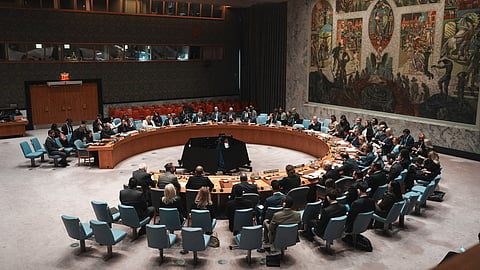
The Security Council has 15 members, including five permanent members, China, France, Russia, the United Kingdom and the United States, who hold veto powers, and 10 non-permanent members elected for two-year terms.
India has long advocated expanding both categories of membership, arguing that reforms must reflect contemporary geopolitical realities rather than the global order that emerged after the Second World War.
India also opposed creating a new category of permanent members with or without veto powers, saying such an arrangement would "entrench the very inequity we are seeking to correct".
"Periodic elections and the concept of permanency are fundamentally contradictory," the envoy said as he recalled that the only expansion of the Council in 1965 increased non-permanent seats from six to 10 while retaining the five permanent members.
He said the change had shifted the ratio of permanent to elected members from 5:6 to 5:10, strengthening the relative position of the P5. The envoy called for a comprehensive approach to Security Council reform, covering membership categories, regional representation, the Council’s size, veto powers and working methods.
Addressing these issues separately, he said, would not deliver meaningful reform. India also called for restraint in the use of veto powers, describing the veto as a responsibility rather than an instrument of narrow political interests.
He pointed two of the five permanent members had not exercised the veto for more than three and a half decades, while most vetoes or threats to use them had come from three members.
He further argued that veto-like powers operated beyond formal votes in the Council. Unwritten consensus rules can allow a single member to block presidential or press statements and decisions by sanctions committees, sometimes without providing an explanation.
The envoy also criticised the use of consensus in the Intergovernmental Negotiations (IGN) on Security Council reform, warning that it could become a "disguised, de facto veto".
"Seventeen cycles later, we have no outcome to show for it," he said, calling for negotiations based on an actual draft text, with clearly defined timelines and milestones.
India is also seeking a non-permanent seat for the 2028-29 term, with elections scheduled for June 2027. It last served on the Council in 2021-22.
