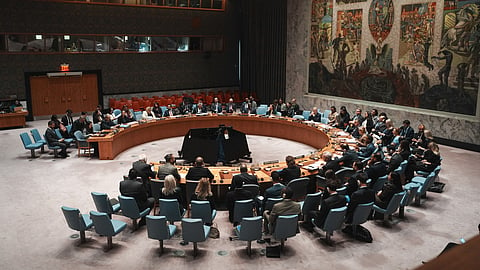

India has asserted that any reform of the UN Security Council that creates a new category of permanent members without veto powers would leave them as “second-class” members without altering the dominance of the existing five permanent members.
Addressing a UN General Assembly debate on the veto on Monday, India’s Permanent Representative to the UN, Ambassador Harish Parvathaneni, said all permanent members of a reformed Council must have veto powers as long as the provision exists.
“India's position on the veto is principled and well known... We reiterate that as long as the veto exists, it must be held by all permanent members of a reformed Council,” he said at the Intergovernmental Negotiations plenary on Security Council reform.
Parvathaneni said creating a separate category of long-term members without veto powers would not change the existing decision-making dynamics, leaving the five permanent members, China, France, Russia, the UK and the US, with their current advantage.
He stressed that fairness and justice demanded equal rights and responsibilities for all permanent members.
India has long called for expanding both the permanent and non-permanent categories of the 15-member Security Council, arguing that efforts focused only on increasing non-permanent membership would fall short of meaningful reform.
Founded in 1945, the Council has five permanent members with veto powers and 10 non-permanent members elected for two-year terms. India has repeatedly argued that the body no longer reflects contemporary geopolitical realities and is ill-equipped to address the challenges of the 21st century.
New Delhi has been at the forefront of efforts to reform the Council and has consistently pressed its case for a permanent seat.
Separately, India is seeking a non-permanent seat for the 2028-29 term. It will contest the sole seat allocated to the Asia-Pacific Group against Tajikistan in elections scheduled for June 2027.
India last served on the Council in 2021-22, its eighth term. Its previous terms were 1950-51, 1967-68, 1972-73, 1977-78, 1984-85, 1991-92 and 2011-12.
(With inputs from PTI)
