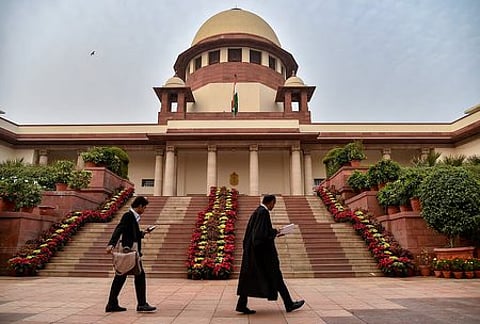

NEW DELHI: The Supreme Court on Tuesday in its order held that overstay after valid entry is not equal to illegal entry and upheld bail to alleged Sri Lankan national under UAPA.
Dismissing Union of India's appeal, a bench of Justice Aravind Kumar and Justice Vipul M. Pancholi upheld the Madras High Court decision granting bail to the person alleged to be Sri Lankan national booked under UAPA.
"We are of the considered view that subsequent revocation of authorization or stay becoming illegal won't attract the rigors of sub-section (7) of Section 43D and it is apposite that initially entry itself should've been unauthorized or illegal. The appellant has failed to place any material on record to prima facie establish the entry as unauthorized or illegal. Even the allegations in subsequent FIR records that respondent had entered India through a valid visa and it was subsequent to the expiry of his visa that his stay became illegal, as such, necessary prosecution under the Foreigner Act has been invoked for the same," the Court said.
The bench noted despite stringent threshold for granting bail to foreign national under Section 43D(7), prosecution failed to establish that accused's initial entry into India was illegal.
Under Section 43D(7) of the UAPA, the prosecution must establish that the accused is booked under the Act, is a non-Indian citizen, and entered India illegally or without authorisation. The Supreme Court said the latter two conditions are conjunctive and must both be satisfied to deny bail, as they are linked by the word “and”.
“Merely proving accused to be foreign national would not be sufficient; it needs to be also proved initial entry was illegal or unauthorized,” the Bench said.
The case concerns the Madras High Court’s decision to grant bail to Rifas. The High Court noted that the Union government had no material other than an intelligence report to establish that he was a Sri Lankan national. It also held that courts had the discretion to grant bail even under Section 43D(7).
The prosecution alleged that Rifas was a Sri Lankan national who entered India in 2009 and overstayed his visa, later obtaining Indian identity documents, including a voter ID, Aadhaar and ration card.
The Supreme Court said that even if the visa overstay was proved, it would not establish that his initial entry into India was illegal. The prosecution had to prove that the entry itself was unauthorised.
The court also held that an intelligence report, without corroborating immigration records, could not establish nationality. It dismissed the Union government’s appeal and upheld the bail order.
