
NEW DELHI: India and Belgium have opened a substantive new front in defence-industrial cooperation, with a clutch of agreements spanning naval mine-countermeasure systems, ammunition production lines, 70mm rockets, Zorawar light tank turrets, electro-optics and counter-drone technologies, alongside a government-to-government framework to deepen military cooperation.
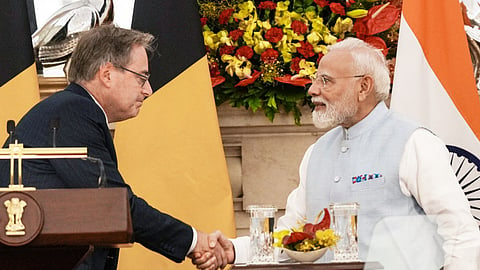
The agreements came as Prime Minister Narendra Modi held talks with his Belgian counterpart Bart De Wever in the capital on Thursday during the first visit by a Belgian prime minister to India in two decades. The visit signals the broadening of bilateral ties beyond the traditional trade and diamond links to defence manufacturing, technology and co-production.
“Defence and security cooperation is a key pillar of our relationship,” Modi said after the talks, adding that the two sides had agreed to enhance military exchanges and training cooperation and that the defence-industry agreements would “open up new opportunities for defence co-development and co-production”.
The push marks a shift in a relationship traditionally anchored by trade, particularly the diamond industry, towards a broader strategic partnership combining Belgium’s specialised defence technologies with India’s manufacturing scale.
The most consequential agreement is between Larsen & Toubro and Belgian autonomous-systems specialist Exail, which is in the fray for the Navy’s long-delayed mine-countermeasure vessel programme. Exail is to provide autonomous systems for detecting, identifying and neutralising naval mines.
The initial programme covers 12 vessels, with the requirement potentially expanding to 59. Mine warfare remains a significant capability gap for the Navy, which has not operated a dedicated minesweeper since INS Kozhikode, the last of its Soviet-origin Pondicherry-class vessels, was decommissioned in April 2019.
The partnership also extends to India’s emerging light-tank capability. Belgian defence major John Cockerill Defense has signed an agreement with L&T for turrets for the Zorawar light tank, being developed for high-altitude operations along the LAC. Its 3105 turret is already fitted on the DRDO-L&T Zorawar prototypes, which have undergone high-altitude and desert trials.
Thales Belgium and Kalyani Strategic Systems will assemble 70mm rockets in India, with the first fully India-manufactured rocket expected in early 2027. Kalyani is separately exploring a joint production centre with Belgian arms maker FN Herstal covering small arms and counter-drone equipment.
Furthermore, John Cockerill’s 60:40 joint venture with Electro Pneumatics & Hydraulics, established in March last year, is to manufacture 59 turrets at a facility in Chakan near Pune. The Army has an eventual requirement for 354 Zorawar light tanks.
Another Belgian company, OIP Sensor Systems, which has supplied more than 130 sights for the Arjun Mk I tanks, is partnering India Optel Ltd on electro-optical systems, including a fire-control system for the Arjun Mk II capable of supporting laser-guided missile launches.
Belgian ammunition specialist Lachaussée has also agreed to supply Tembo Classic Engineering with a complete production line for two ammunition calibres, with tooling for two additional calibres. The proposed facility will have a capacity of about 100 million rounds annually and is valued at roughly €50 million, with installation planned during 2028-29.
Other agreements cover loitering munitions and counter-drone systems. Belgian company Sol1 has partnered DGVK Enterprises to offer its Saboteur loitering drone and Buzzkill and Hitchhiker interceptor systems. Krishna Industries and Pitagone are setting up a joint venture for mobile anti-vehicle barriers, while the Society of Indian Defence Manufacturers and the Belgian Security & Defence Industry association have signed an industry-level cooperation pact.
The agreements were exchanged at an India-Belgium Defence CEOs Roundtable co-hosted by Minister of State for Defence Sanjay Seth and Francken.
Meanwhile, the Letter of Intent between the two defence ministries focuses on staff talks, officer exchanges, education and training, research and development, joint exercises and cooperation on maritime security and emerging technologies.
Belgium will now appoint a defence attaché in New Delhi, while India will post a resident defence attaché in Brussels. The Belgian Navy frigate LEOPOLD I is scheduled to visit India in November.
The joint statement also recorded Belgium’s solidarity with India in the fight against terrorism and its condemnation of the Pahalgam terror attack. The two countries agreed to explore establishing a Belgium-India Joint Working Group on Counter-Terrorism.
The defence push forms part of a wider attempt to recast bilateral ties. Modi and De Wever agreed to work towards doubling bilateral trade over the next five years, supported by an Investment Fast-Track Mechanism.
Modi acknowledged the traditional economic foundation of the relationship but signalled a broader ambition. “Diamonds have long been a link between India and Belgium. Today, we are transforming this historic connection into a new and more comprehensive relationship.”
